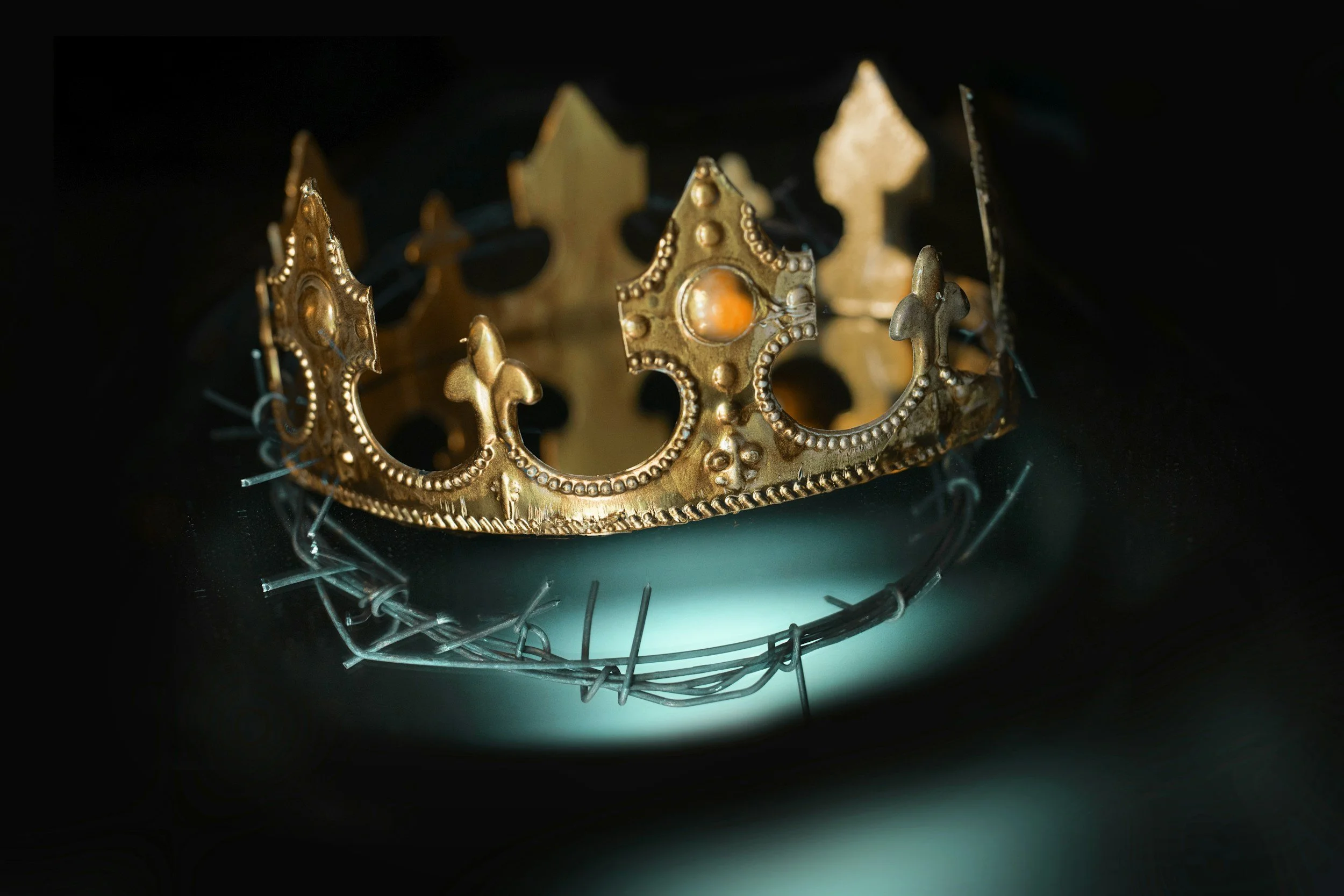
The True and Selfless King
This sermon was preached by Pastor Ted Carnahan for the Feast of Christ the King, November 23, 2025.
Grace, mercy, and peace be with all of you from God our Father and from our Lord and Savior Jesus Christ. Amen.
I've been thinking a lot this week about the question of whether our faith is measured more by what we do when things are easy or by what we do when things are hard. Because you can think about it both ways.
If things are easy, it's sort of if things are good at home and things are going well, then you can say, I'm just going to do the right thing. What do you do when nobody's looking? There's integrity in that. If things are easy and you're doing the right thing anyway, then that shows that you've been formed by a certain sense of integrity that makes you choose the good even when it might feel a little more optional.
On the other hand, what we do when things are hard is equally compelling because, of course, when the rubber meets the road, when we're tempted to take shortcuts and to commit ourselves to things that would be displeasing to God, will we stand for what's right and not take the easier path?
In terms of overall faithfulness, some people, maybe that was their wake-up call, but a lot of people, they came looking for something therapeutic. They came looking for a sense that God was in control and it was going to be all right. And as soon as they received that, they went off and did their own thing again. Because the people who came back to church in the middle of that crisis were looking for something therapeutic. They were not looking for a God who is king.
The Feast of Christ the King
Today is the Feast of Christ the King, but people want to tone that down. Our most recent hymnal even tries to lower that. Instead of Christ the King, it says it's the Feast of the Reign of Christ. Because we're trying to get rid of the masculine language of king. King that tells us that somehow we have to do something for this one who commands us.
The reign of Christ, though, doesn't really avoid the issue because the word reign comes from the Latin regnum, which means kingdom. So they tried, but they failed.
Still others will, in their attempt at being perennially politically correct, try to modify the word kingdom to turn it into the word "kindom." Because they want to emphasize that we are kin, that we are family, that we are brothers and sisters.
But the Feast of Christ the King, to say nothing of the scriptures themselves, will not admit this possibility. Christ is not merely our family, our kin, but he is our king. And frankly, the phrase "the kindom of God" just sounds stupid. King is a good word to use for someone with this kind of power and authority.
But we aren't very good at understanding what king, what kind of king, King Jesus is.
The Thieves on the Cross
The people crucified with Christ that day on the Hill of the Skull also did not understand this idea of kingship. Because in our world, kings have kingly prerogatives. The kids knew it. They have crowns. They have maybe scepters and thrones and money. They knew that kings have money. They have power and authority and they can get what they want.
The thief on the cross, the first one who turns to Jesus, says, "If you are the king of the Jews, save yourself and us." Jesus, if you really are the king that everybody says you are, then you can use your authority to benefit yourself. This is what we would expect from a king, isn't it? They will use their power, their wealth, their fame to protect themselves first.
The devil uses this, the taunt of the devil against God as Jesus is tempted in the wilderness. He says, "If you are the son of God, command this loaf or this stone to become a loaf of bread." And he says, "No, I won't be tempted by you. I won't obey you." And then he says, "If you will, but worship me, these things will be yours." Just be less of a king and treat me as king and you will have what you want.
Expectations from Earthly Kings
Israel was told what to expect from a king as the people clamored for an end to the age of the judges where God raises up leaders for them in particular situations of crisis. They say, "We're tired of this cycle of repentance and renewal. We would much rather have a king because if there was a king, he'll tell us to do what we need to do but we don't constantly get conquered by our neighbors."
And the prophet is commanded to tell the people, if you take a king, he will use his power and wealth that he takes from you for his own benefit.
Here are some ways kings were expected to act:
- He'll take the best of the land.
- He will take your money in the form of taxes.
- He will even take your sons and daughters to serve in his court and in his army.
And frankly, this is what we expect from kings, isn't it? We expect from great leaders and tyrants that they will use their power and authority first for their own benefit and not for the good of the people around us.
In fact, it's interesting when we do run into the occasional king who seems to be dedicated to helping the people of his kingdom, we see that as remarkable. We see that as being somebody who's extraordinary and unusual because we know what kings do.
The Inscription and the Cross
And so as Jesus goes to his cross, they write an inscription over him. Pontius Pilate orders it to be written, "Nazareth, the king of the Jews." In fact, some of the Jewish leaders were offended that he would write it that way. They said, "No, no, change that. It should be written, this man said he was king of the Jews." And Pilate says, "What I have written, I have written."
They intend for it to be mockery. Just as the cross is intended to be a mockery. As Jesus is hung, exposed and naked, bleeding and dying, he is posted by one of the gates of the city so that as people come in, they can see powerfully the testimony of what Rome does to those who would oppose them.
But the sign above Jesus' head, by the way, have you ever seen that abbreviation? It'll just be four letters, I-N-R-I. That I-N-R-I is just an abbreviation for the Latin, Jesus of Nazareth, king of the Jews.
He who hangs upon the cross, bleeding and dying, shows us that God uses his power and authority differently than we would, certainly differently than we would expect. He doesn't just use power for his own benefit. In fact, frankly, what would that even look like? For God to need something would make him not fully God. To use his power for his own benefit, what benefit does the one who created the universe and all that is in it, what benefit would he need? He doesn't need anything. He has securely within himself all things. He doesn't even need us.
God's Purpose and Love
So then why do we exist? He created us because he is a God who is, in his very essence, in relationship to himself. And he wanted to have a relationship with another created in his image. He will use his power, then, to restore us out of his great love. Not because he needs us, but because he desires to see that all people would be saved.
He calls upon us to trust him. And then he himself goes to the cross. He will use his power, but not like earthly kings do, to benefit themselves, to gladden their own hearts, to gain for themselves glory. He will use it for his beloved other.
We're so unused to thinking of power and authority in this way that it seems to us to be weakness. That one thief dying on the cross sure thought so. "Save yourself and us." Use your power. You can benefit yourself, so you must benefit yourself. And if I get to come along on the ride, that would be really great, I don't want to die here today, Jesus.
But that man didn't understand what was at stake. Because none of this was for God's own sake. It was for the sake of people that he loves. It was for you that Jesus Christ went to hang upon that cross.
And the other thief recognizes that the first one is off base. He recognizes that he is a sinner who has been justly condemned and needs a Savior. And then he says something that is utter nonsense if it's not rooted in something deep and true. He says to another man bleeding and dying on a cross, "Jesus, remember me when you come into your kingdom."
Think of what that means. He is saying, in essence, Jesus, as you bleed and die here with me upon this cross, I believe that you are a king. And even though you're dying here with me, somehow you will come into your kingdom. And you have the power to bring me along with you when you do.
What a remarkable statement of faith from a man who is in terrible pain. Here this man is staking everything, even the fate of his own immortal soul, on something he can only grasp by the purest of faith. That somehow this naked and dying man to his side is the Messiah of God and Israel's true coming king.
Faith in Suffering and God's Promise
Suffering will do that to you. When you have everything under control and everything is going well, it's easy to forget about God and hang on to yourself. But when things go bad, you realize you must cling to something better.
The harsh words against God by the people in our reading from the prophet Malachi today really are our questions too. They say to God, "It is vain to serve God. What profit, what do we profit by keeping his command or going about as mourners before the Lord of hosts?" Things are going well for us. What profit is there in it for us to worship the Lord? What profit is there to keep his feasts and festivals, this day, the feast of Christ the King? Why not do our own thing? Do we get anything out of it?
And they continue. "Now we count the arrogant happy. Evildoers not only prosper, but when they put God to the test, they escape." Why not just be arrogant and not under God's dominion? It seems to us that evildoers prosper, and when they test God, they get away with it.
But here God has an answer for us. Those who love him and keep his commands, who are faithful to him, both in good times and bad, shall be my special possession on the day when I act, and I will spare them as parents spare their children who serve them.
The one whose first throne was the cross and whose first crown was one of thorns will return in majesty and power, and every knee in heaven and earth will bow, and every tongue will confess that Jesus Christ is Lord. Kurios, Greek, Lord or King.
God shall be our Father on the day when he acts, and there will then be drawn a difference between them and us, and those things which we see today as injustice will be made right.
Wisdom for us today is the understanding that the difference that will make in the future is worth doing what needs to be done to write that upon our lives today.
And this great King, Jesus Christ, is not just powerful, but he is good. He is merciful and loving and self-sacrificing in ways that no earthly king is. He needs nothing. But we need him with all our hearts, and he gives to us grace upon grace. And he stands willing to give even to the point of death, even death on a cross.
So we will turn to the Lord, for he loves those who fear him, and keeps his commandments as a father loves his children. He is our refuge and strength, our present help in time of trouble, and we will cling to him, not just in hard times, but in good times as well, because we know that he will be faithful to us now and in the future, even to the point of death.
So trust this word of God and hold on to the hope of eternal life. With our glorious King, Jesus Christ.
And may the peace of this crucified and risen King keep your hearts and minds strong in Christ Jesus, our Lord, to life everlasting. Amen.