Reading Theophanes’ John the Baptist
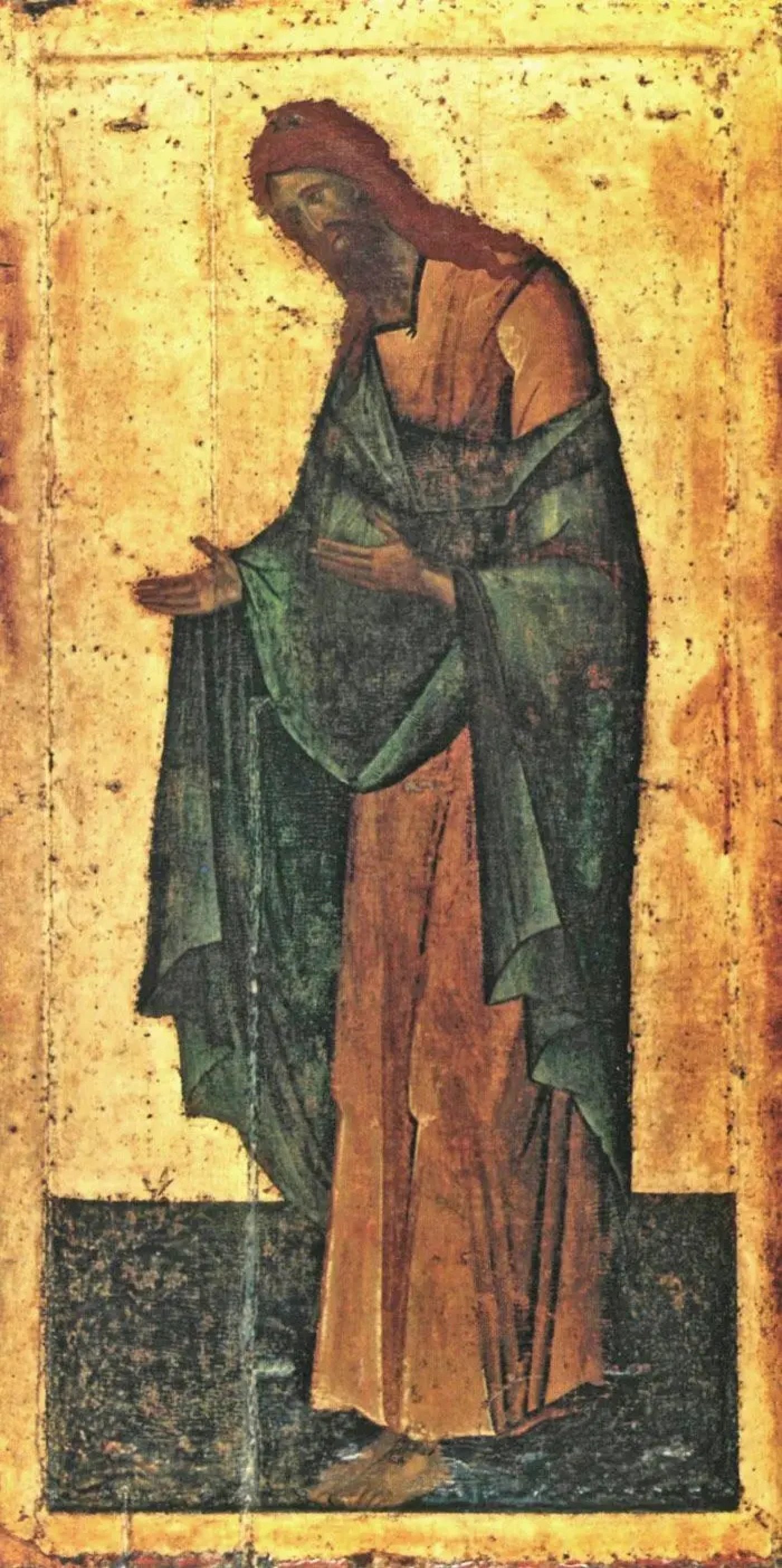
This sermon was preached by Pastor Ted Carnahan for Midweek Advent Worship on Wednesday, December 10, 2025. The icon in question, Theophanes the Greek’s Icon of John the Baptist, can be seen at the bottom of the sermon transcript.
Grace, mercy, and peace be with all of you from God our Father, and from our Lord and Savior, Jesus the Christ. Amen.
Tonight, we "read" an icon of John the Baptist. Remember that from last week, we said that we don't just look at or study an icon, but we read it, and in the same way, an icon, when it is created, is not painted, but we say that it is written, as like a word that we write down.
Words are important things. We use words for specific reasons. If I said, "Who would like me to bring them a toilet," you all would look at me like, that's weird and gross, and I don't think I would like that. But if I told you that this is a toilet, would you like one? (It's a Hershey's bar.) You might be more inclined to say yes, or you might wonder, where has this Hershey's bar been?
The important thing is that words are signs, and we use correct words, language about God, in order to point to the reality of God.
We call this a candy bar, and we don't call it a toilet, because if you call it a toilet, it means something else. The word candy bar points to the reality of the delicious chocolate inside.
Words are signs, or in another way, we can say that they are icons. Last week, we said that icons are images that point to another reality.
For example, the little floppy disk icon in your Word document, it points to the reality of saving to a disk. Of course, we don't use three and a half inch floppy disks anymore, but it still points to a different reality.
We use analogies when we don't have an easy way to talk about things. It would not make any more sense if we were to have a little picture of a microchip in our Word documents, because that's where a lot of us are saving our documents now. They're saving them to solid state drives, but you, as an ordinary end user, don't give a rip what kind of drive you're saving to, and trying to give you the technical details and keeping that up to date is less important than the idea of a functional image that points to another reality.
The Icon of John the Baptist
Here, tonight, we are studying this icon of John the Baptist, the one about whom our Gospel lesson both tonight and last Sunday were about.
John the Baptist has appeared in the wilderness, and he also is to serve as a sign. As you look at this image of John, you consider him, you notice some things right away.
First of all, you will notice that he is not looking at you. In a lot of icons, the person being depicted, whether it be one of the saints or Jesus himself, he's looking directly at you. His gaze is fixed on you.
In fact, some icons are so striking and stunning that it's difficult for us to take our eyes off of them. This is all very intentional, that they pull our gaze in, they lock our eyes with theirs, and we are meant to be drawn into contemplation of who this figure was, and what they mean, and what they meant then, and what they mean for us today.
But John, in this particular icon, doesn't look like that. Instead, the man Theophanes the Greek has depicted him in a very traditional way for John the Baptist.
His head is not upright. His head is bowed — he's humble. His head is turned to one side. You look at his eyes, look at his pupils there, you'll see that his pupils are not looking down and to the side, not kind of looking to see if we're interested in what he's doing. He doesn't care what we're doing. Those of us on the outside of this picture, gazing in, are not important to John.
What's important to John is whom he is looking at. His pupils are turned to his right, and they're facing out of the painting. He's looking at someone. His hand is extended in a gesture. He's pointing. Actually, both hands are extended in a gesture. He's pointing off to his right. His eyes, his head is bowed. He's looking off to the right. He's looking out of the image to his right.
The Iconostasis
That's because this icon was not meant to be read in isolation. It was not composed as a stand-alone piece of artwork to be contemplated. It was meant to be included in what the Orthodox Church calls an iconostasis.
An iconostasis is a wall of icons. Theophanes the Greek was responsible for constructing, pulling together several of the sacred icons for the Cathedral of the Annunciation, located in Moscow, in the Kremlin.
The Moscow Kremlin's Cathedral of the Annunciation would have featured at the time other works by Theophanes the Greek. Also Theophanes' protege, his student and assistant, whom you've heard of because we talked about him last week, Andrei Rublev, the one who composed the Icon of the Holy Trinity that we looked at.
This icon is not meant to be read in isolation. It points to a reality beyond itself. It is humble. John is not inviting you to reflect on how good and interesting and perfect a man he is, but rather the One to whom he points.
Details in the Icon
There are other details worth noting as well. I've mentioned before the big eyebrows, the strong brow line, the long nose, all emblematic in iconography traditionally of wisdom. John, of course, was wise.
But you'll also notice his beard is long and tangled and unkempt. His hair is long, down to his shoulders at least. This is a man who has spent a lot of time out in the wilderness.
If you consider other icons of John from this time period, even other icons that are attributed to Theophanes the Greek, because he composed more than one image, you'll see that he spends a lot of time focusing on John as an inhabitant of the wilderness, as a man of the desert, like the saints of the desert in the early church.
Moreover, if you look at the garments that he's wearing, he is clothed in brown, perhaps that is his camel's hair clothing, but also in blue because he's being honored as a saint and honored in pointing to divinity.
The blue garment is not primarily around his shoulders, but rather around his arms and hands that are gesturing off to the side, pointing, we think, to Christ.
The lines of his garment, the way that it drapes, are intended to draw our eyes up from his feet, up from his legs. There's no place for our eyes to rest below his waist at all. Our eyes are always drawn up, pointed towards his hands and then ultimately his head, which then themselves point us off to a different reality.
John as an Icon Pointing to Christ
This image is not just an icon. It is an icon of an icon.
The artist does not want us to focus on his artwork. He does not do any of the traditional things that you would expect even an iconographer who's depicting John the Baptist to do. He does not invite you to dwell on his image, but rather he invites you to dwell on the one to John's right. Or our left as we face the picture.
This is John himself telling us, "Don't look at me, but look at Christ. Don't look at me, but look at the One to Whom I am pointing."
Icons are meant to be symbols, signs that point to something else, and that is John's purpose. A sign that points to something else.
Isaiah announces this in his prophecy: "Prepare the way of the Lord, make his paths straight." John takes up the mantle of this ministry and prepares the way of the Lord for Jesus and points not to himself and his own ministry of repentance, but points to the one of whom he says, "I'm not even worthy to untie his sandals."
Humanity as Icons of God
Ultimately, that's not just John's purpose. That's our purpose too. Genesis 1 says that we are created in the image and the likeness of God.
Sometimes we lose track of what that really means. Sometimes we make this too facile and simple and shallow. We say that, well, in some important sense, we look like God or that eventually God is going to become incarnate in Jesus and he's going to look like a human.
This is not what we mean by the image of God at all. What we're saying is that we are created in the image and likeness of God because there is something fundamental, special, and set aside about human beings that is noteworthy and different than any other part of creation. That we are made in the image of God. That we are like images that point to a different reality.
I'm not saying that we are gods. We're not gods. But God has created us with dignity and value and the ability to have faith. But more than that, when you look at those who follow God, we are to be icons, images that point to another reality.
That we are fallen creatures does not erase everything of that image within us. It does erase our ability to live according to faith in God, but it doesn't erase the dignity that we have as God's creatures made in his image.
But that we are the image of God means in part that we are signs or symbols who point to God. We are flawed signs. We are incomplete signs. We are not a perfect representation of what God is. We once maybe had that before the Fall. But on this earth, in this time, it has become lost — but not irretrievably.
We may be flawed and incomplete signs, but we regain some of that dignity and that purpose in Baptism. As we are reconnected with our true selves, we are given the righteousness of Christ. We are remade images or icons of God. We're given righteousness in Christ and the gift of faith in baptism, and that allows us to live in God's presence. It allows us to hold out hope to our neighbors. It allows us to love others as God has himself loved us in Christ.
Therefore, John's purpose of pointing to Christ is in that sense also our purpose. We also are to point to Christ.
It's not to be the spotlight on us. For those who follow Christ, it's not all about you. It's about Him. Not about our goodness, but about God's goodness. Not about our righteousness, but the righteousness of Christ alone.
The Role of Israel and the Church
Incidentally, that's also what Israel was meant to represent to the world, which is really at the root of the whole disagreement between John the Baptist and the Pharisees. Because the people of Israel were meant to be a people chosen and blessed by God so that they could represent the goodness of God to an unbelieving world.
They also didn't live that perfectly, but at their best, they preserved and passed down the legacy of faith from Abraham down to us.
The Pharisees misunderstood that. They thought that being children of Abraham had to do with being generated from Abraham by descending from him. They thought that their ancestry made them children of Abraham, but actually it was their faith and trust in God.
The true Israel today is all those who trust in God by faith. That faith comes to us Gentiles in the person and work of Jesus Christ. The church has been grafted into that true Israel.
We are a part of God's work in the world, holding out the light of God in Jesus Christ to all people so that they might see the goodness of God, that they might see that there is a different way to live and a different way to be oriented towards the world, that we can see that it's not us who have the upside down thinking about the world, but it's the world that's gone wrong.
We get to point to the goodness of God!
Conclusion and Benediction
As you prepare for Christ to come at Christmas, remember that you are to point not to your own goodness or your own abundance or your own happiness, but you are to first point to the abundant life and salvation of God in Jesus Christ.
That's the purpose to which every Christian has been called, not to make it about us, but to make it about Him.
May you know that peace and may the peace of God, all understanding, keep your hearts and minds strong in Christ Jesus, our Lord, to life everlasting. Amen.