Reading the Icon of the Annuncation
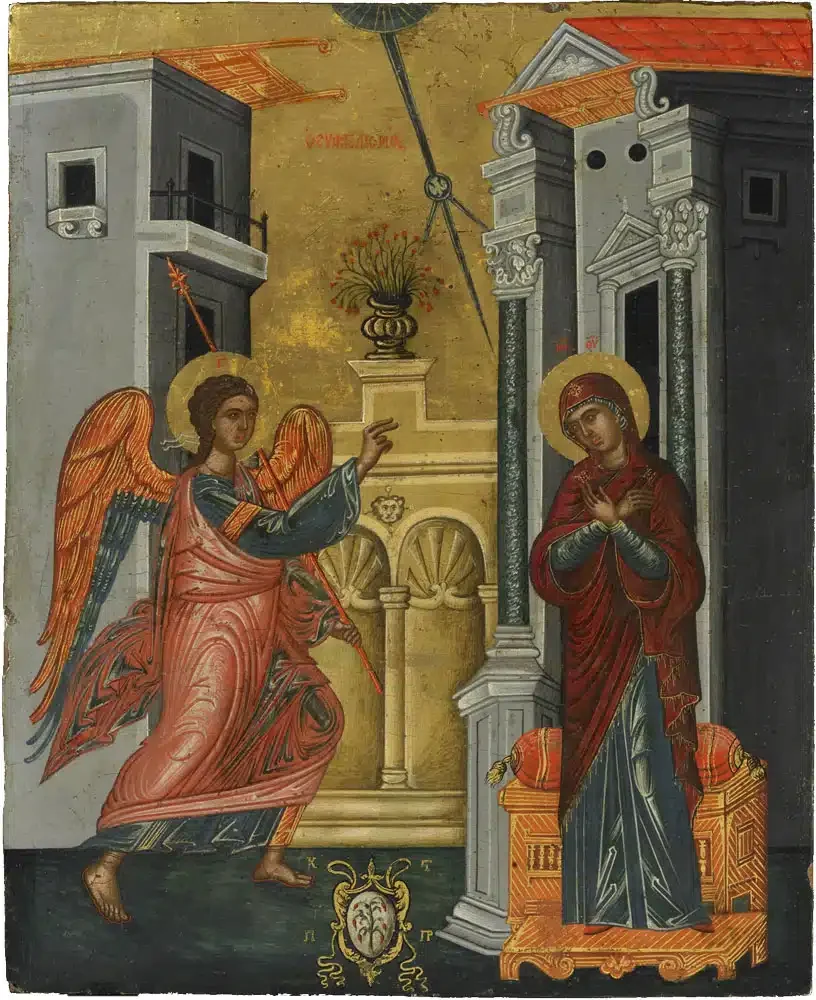
This sermon was preached by Pastor Ted Carnahan for a Midweek Advent Service on December 17, 2025. You can view the Icon of the Annunciation being referred to in this sermon at the bottom of the transcript, below.
Grace, mercy, and peace be with all of you from God, our Father, and from our Lord and Savior, Jesus Christ. Amen.
Tonight, we've been reflecting on icons, and the icon for this evening is the Byzantine icon of the Annunciation. The Annunciation is the fancy term that we give in the church for the announcement to Mary that she will bear the Son of God.
It's one of those funny things because a lot of icons are part of an "iconic tradition". This one is no exception. In fact, I was actually originally going to use a much older version of this icon, another one that had been painted from a couple centuries earlier than this one. I went with this one because that old one has become so cracked and clouded with time that I wanted to try out some of the interesting features that are much more obvious in this one.
Tonight, I want to reflect a little bit on what's going on here and what it has to do with you and me.
The Title
Starting off at the top, you'll find that there is light kind of orangish-red lettering. Don't worry that it's difficult to read because it's not in a language that you read. It is in Greek.
It is in all caps because in theology and biblical studies, we cannot use normal terms that everybody else does. We have to use special ones. So if it's all lowercase, it's minuscules. And if it's all caps, it's majuscules, which I think they just made the second one up to make it fit with the first one, but that doesn't matter.
What it says there is Ο Ευαγγελισμός της Θεοτόκου, (O Evangelismós tes Theotókou), or the Annunciation of the Godbearer. And if you're listening to me say that word, there's an English word that you might find embedded in it. It sounds like the word angel. Well, that's because it is.
The "evangel" is the good news. (Evangel being a kind of a misinterpretation of certain letters in Greek coming into Latin and English. It doesn't matter.) The point is that you have this word that originally means the good news, the announcement of the good news, the announcement of a messenger. That's what angelismos means. It's angel. It's messenger. And that's what an angel is. It is a messenger.
We have this, just in case you didn't know what you were looking at, if you knew a little bit of Greek, you could look at this Greek Orthodox, Byzantine icon, and you could say, "ah, this is supposed to be the Annunciation!"
The full title of it adds two other words to it. The Annunciation to the God-bearer, to the Theotokos. And that's going to be an important word that we're going to talk about a little bit later.
The Background
But first, let's describe what we see in the image. We see Renaissance era architecture, because each of these icons, as it's painted, is painted with the trappings that the artists would be familiar with. So they're not wearing ancient Near Eastern clothes. They are wearing medieval Renaissance type clothes. (Or what people in the Renaissance imagined that people in the ancient Near East would wear, because they're trying to communicate this image)
We have the archangel Gabriel. By the way, you ever notice the difference between angel and archangel? Arch just means high or top. Sort of like the St. Louis arch is a very high arch. And so the archangel Gabriel is the one, he is one of the high angels, one of the highest of the angels.
The Archangel Gabriel
Gabriel sweeps in from the left. Now you'll notice some things about him.
- You'll notice he's not wearing any shoes. (I just think that's interesting. There's nothing important about that.)
- You'll also notice he's got lots of flowing robes, but the flowing robes are red, which is what we associate with angels today.
- And his inner garment is blue, which is a color of divinity. We'll talk about that in a little while too.
- And he's holding in his hand a spear. So he has a weapon. This angel is armed.
In his other hand, he is, as he leans in, sort of doing a lunge to the side. As he leans in, his hand is raised in a gesture. I'm willing to guess that everybody here tonight has seen that gesture made before, because it is a gesture that I make as a pastor, bringing you a blessing. And I'll often do this. Notice it's the same thing that the angel is doing in this picture.
And so what's the significance of this gesture? Well, he's raising his right hand in a gesture. And he starts his dialogue with Mary by saying, "The Lord is with you. Blessed are you among women."
His thumb and his ring finger are joined, and his pinky finger is down with those two. And the idea here, there's a couple things going on.
- One, the idea of the ring finger as being directly connected to the heart.
- The other is that what you have when you have a gesture of two fingers with the one thumb here is you have the Trinity, three fingers, and then two fingers for the two natures in Christ, which you'll notice if I turn it around for you, you get kind of a chi shape or an X.
And that X, the Greek letter chi, is actually a C, the first letter in the name Christos or Christ. And so he is bringing a greeting. Now, his fingers are not crossed that way. In the other icon, he makes a slightly different gesture. Just connecting his ring finger and his thumb. And again, we have three and two. Three for the Trinity and two for the natures of Christ, connected to the bloodline through the ring finger, which is the blood of humanity.
Yes, there is a lot in a gesture. And he is bringing a Trinitarian, Christological gesture to Mary. The angel Gabriel, he is symbolizing the coming in of the divine person of the word of God made flesh in Jesus Christ.
Mary, the God-Bearer
Then to the right of the image, we have a picture of Mary herself. Mary is standing on a pedestal. The pedestal appears to be gold because we are depicting her as royalty. And notice that she has, now in this image, she is not seated. In the other one I was going to show you, she is. But in both cases, the golden pedestal or throne, backless throne that she can sit on, has a red cushion on it.
And she herself is clothed in red. She has a halo. And so you will see, if you look very closely, you'll see the halo there. You will also see some letters on her shoulders. They're very difficult to read, but they (probably) are the abbreviation in Greek for "The mother of God".
And so this holy one, this virgin, is standing. And she has, in this depiction, her traditional stance, which she has her left hand across her right, and her hands are crossed. Again, you see another Greek letter. It's, again, the chi or X, of Christ.
She's standing. She's wearing robes of red. Her head is tilted downward to show deference to the angel and her submission to God. And her inner robe is blue.
Now, we've seen blue now twice. Blue in Mary, but also blue around the angel's robe and also tinging the wings. What's going on with blue? In fact, if you look at traditional depictions of the Blessed Virgin Mary, you will find that she is almost always clothed in blue.
In fact, when we had the Lighthouse Christmas program on Sunday and I realized that we didn't have anything blue to put on Laura so she could play the Virgin Mary, I had Anneliese run home and she found a blue blanket to put on her because everybody knows that the Virgin Mary's color is blue!
Why? Well, there are lots of reasons that have been brought into it. Some are not ones that we as Lutheran Christians would hold to. For example, some of the Roman Catholic claims that she is the Queen of Heaven and that's the color of the sky and the Queen of Heaven sky blue thing going on there.
But actually, the real reason, the older reason, is because blue was a symbol of divinity and royalty. Blue originally was a pigment that was extraordinarily difficult to obtain, second only to purple. And so blue and purple were royal colors. And royal blue was an especially dark blue because you had to use a lot of that very expensive pigment.
It comes from lapis lazuli, which my children will tell you is something that you can get in Minecraft and you can turn into powder to use as a dye. And that's accurate! The lapis lazuli is a royal pigment. And so it is honoring this Blessed Virgin with the robes of royalty, the throne of royalty. We'll talk a little bit more about royalty in a moment, but I do want to mention the background.
The Background and Symbolism
We have two buildings. The buildings are very much period Renaissance buildings and not buildings like they would have had in the ancient Near East. Certainly nothing with pillars anywhere near where Mary, who was a very poor person, would have lived.
At the top, though, you'll see a blue semicircle right at the top of the image, just barely peeking out of the top of the frame. And that blue is streaked with golden rays. Symbolic of the unity of God.
And then you'll see a blue, divine, royal ray of light pointing down, not towards Mary's head, but pointing towards her abdomen. And in that ray, you will see where the ray splits into three pieces. Symbolic of the Father, the Son, and the Holy Spirit. But it is the Holy Spirit who is at the center of this division because it is the Holy Spirit who will overshadow Mary and cause her to conceive the Son of God.
The only other thing I want to highlight is that not everything in an icon is always of religious significance. If you look at the bottom, you'll see this coat of arms. I'm not 100% sure what the Greek letters around it are, but the coat of arms is almost certainly the coat of arms for the patron who paid for the icon to be made. Because you wouldn't want to be left out.
And in a lot of these medieval and Renaissance paintings, you'll find little details where the patron of the images has been worked into the painting. And so, you know, you might have the Last Supper, but the guy who is St. Peter or St. John being very close to Jesus is painted with the face of the patron who paid for the image to be made.
In other cases, you'll find in Lutheran art, I've seen several times, and I know it's present in other places too, where there were enemies of the painter who get painted as the bad guys in the picture. Lucas Cronach the Elder, who was a very famous Lutheran Reformation era painter, was famous for doing that a couple of times, including people that were jerks to him as devils and demons and evil men.
The Message for Us
So now we have this Blessed Virgin, this royal figure clothed in blue and red with a halo around her head to indicate her blessedness and holiness. And along with that of the angel standing at her side. And this angel giving this Christological Trinitarian blessing and bringing this good message, the enunciation of good news to this poor woman and the act of God sending forth the Holy Spirit to cause her to conceive and to bear a child.
Which is why we, as even Lutheran Christians, confess that the Blessed Virgin Mary is the Theotokos. Theotokos is a Greek word meaning the God-bearer. She is the God-bearer. And she is properly called the Mother of God because she was the mother of the blessed Son of God, Jesus Christ, our Lord.
And what she does in the Incarnation is she is willing to undergo all that will be involved in bearing this child into the world. The shame of being treated as if she is an unwed mother when she is virginal and pure. The confusion that comes from raising such a child and having to navigate what the world is like with a child who is also the Son of God.
And then knowing, somehow knowing, that this one is destined for the rising and fall, the rising of many in Israel, and that a thorn will pierce her own soul too as she receives a prophecy. Growing up knowing that something about this child is different and is going to bring her pain.
And yet she willingly says yes1 She willingly welcomes the Holy Spirit. She willingly welcomes and bears this child who is not merely a great prophet, but the divine Son of God.
May you also, in this season of waiting for the coming of Christ, hear the call of the Holy Spirit to faith. Trust His word. Say yes to His requests of you. Follow Him where He leads you. And may in that following, you find your true identity. May you find your holy yes. And may you be a member of the way of peace. In Jesus' name. Amen.