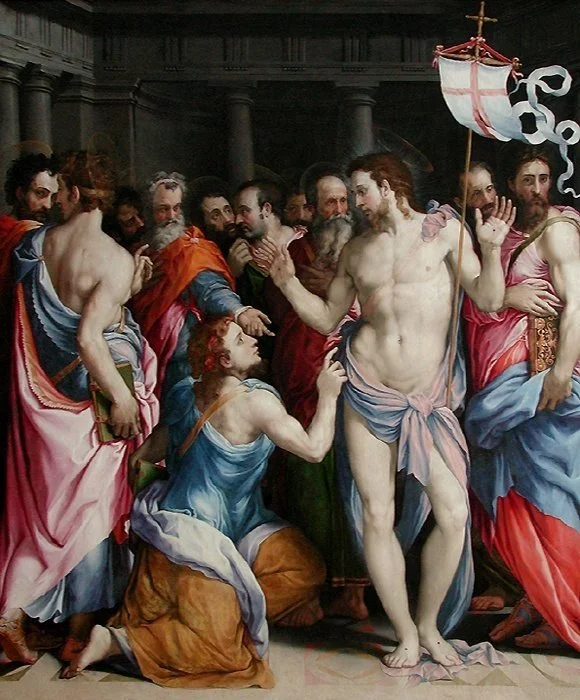
My Lord and My God!
This sermon was preached by Pastor Ted Carnahan for the Second Sunday of Easter, April 27, 2025.
Grace, mercy, and peace be with all of you from God our Father and from our Lord and Savior Jesus Christ. Amen.
Do you have a nickname? I have a nickname. In fact, most of you call me by it. My given name, my legal name, is Theodore, which sounds very imposing. Usually, if somebody calls me on the phone and wants to speak to Theodore, they’re either trying to sell me something or it’s a scam. If someone calls me Theodore, I know it’s usually not legitimate. I wish I could treat bills the same way, but sometimes they put my legal name on those too.
My nickname is Ted. I go by Ted because it’s shorter and less imposing. I feel more like a Ted than a Theodore. I imagine someone named Theodore is probably 80 years old with a big white beard. Maybe when I’m 80 with a big white beard, I’ll be "the Reverend Theodore Nelson Carnahan." But not today.
Nicknames are a funny thing, though. Especially among guys, the nickname you get from your friends usually isn’t a compliment. Along the same lines, I find the call signs of fighter pilots and the stories behind how they get their nicknames kind of funny. You’ve all seen Top Gun, where the fighter pilot’s call sign, his nickname, is Maverick. His buddy who dies in the first movie—sorry if I’m spoiling a 30-year-old movie—is Goose. There are reasons why they have these names.
In the military, nobody actually has a cool nickname like Maverick because you don’t give yourself a fighter pilot call sign. It’s given to you by your peers, often based on something dumb you’ve done. Incidentally, the names they give out as call signs usually have two meanings: the publicly acceptable meaning and the real reason they got that name.
I have to walk a fine line here, but I wanted to share a few funny nicknames I came across. For example:
- A guy whose last name was McFeely had the call sign Touchy. Touchy McFeely.
- A vegan pilot’s call sign was Meat Sweats. I love that one.
- A guy whose wife packed his lunch every day was called Juice Box.
- A guy with the last name Manship—M-A-N-S-H-I-P—got the call sign Dude Boat.
- A guy had a cool-sounding nickname, MOTO, like motorcycles or motocross. But it actually stood for Master Of The Obvious because he always stated obvious things in briefings and meetings.
- Air Force General James Holmes had the call sign Mobile. Mobile Holmes. That’s pretty funny.
- One of my favorites is Douglas Corrigan from the 1930s, the second person to fly across the Atlantic Ocean. After Lindbergh did it with great fanfare in a fancy plane, others wanted to try too but were denied permission. Corrigan, with his janky, slapped-together plane, allegedly took off to fly west across the country but “accidentally” flew across the Atlantic to France. They called him Douglas Wrong Way Corrigan. The funny thing about Corrigan is there’s almost no chance he flew 14 or 15 hours over the ocean before realizing he might be going the wrong direction. That’s the story he stuck with to his dying day, mostly to avoid trouble. He knew he flew to Ireland because he wanted to.
Nicknames are sometimes cool, but usually, especially for men, they’re not flattering. I have another nickname I didn’t share with the Saturday service. I got a pretty cool nickname because I was a founding member of my high school’s Meat Club. That was a real thing, a real club with a sponsor. It started because the vegetarians formed a club and put up a big poster of Bart Simpson saying, “Don’t have a cow, man.” I kid you not. We thought, "Well, that can’t stand."
There were about five kids in the vegetarian club, and I decided to be part of the group that started a meat club. We immediately had 50 members. We would have BYOM parties—bring your own meat. My nickname from that club—and this is real—was Ted 'the Carnivore' Carnahan. We also had officers like the Prime Minister of Prime Rib and the Sultan of Steak. We really went all in.
The Unfair Label of 'Doubting Thomas'
Thomas today gets a bad rap because you all know him as Doubting Thomas. It’s really a shame because Thomas does doubt when he hears the word that Jesus has risen from the dead proclaimed by his peers, the other apostles, since he missed being there the first time Jesus appeared to them. But I don’t think Thomas deserves the nickname Doubting Thomas.
He was given this nickname for something he did over the course of about one week, yet now everyone in the whole world calls him Doubting Thomas. This man believed in Jesus and followed Him for three years, dropping everything to do so. From Maundy Thursday, when everyone abandoned Jesus, until Resurrection Day, he was among those who left Him. For a week, he had his doubts. Then he exclaimed, “My Lord and my God!” From that point until the day of his death, he faithfully followed Jesus and proclaimed the Word.
Yet over what amounts to ten days of doubt, that became his label for us, at least in the English language. I don’t think that’s fair. Especially because I think the story of Thomas’ doubt, rather than being a sign of his unfaithfulness, is actually a beautiful story that encourages you and me as we wrestle with our own doubts.
The Honesty of Thomas’ Doubt
First of all, the story of Doubting Thomas is beautiful because it is honest. The story of Christ’s resurrection is unbelievable. It’s difficult for us to believe. We know how the world works. We know that dead men do not rise. We know that once Jesus was crucified and put into that grave, He was not supposed to come back again.
The guards posted at Jesus’ tomb were not there to keep a living man in; they were to keep living men out because Pilate, Herod, and the chief priests were trying to prevent people from taking His body and claiming He had risen from the dead. Yet here comes Jesus—the angel rolls the stone away, and Jesus is already gone. He has already risen!
If there were no tangible proof of that, it would be difficult to believe such a thing. In fact, John reminds us that Jesus says to Thomas and the other apostles, “You have believed because you have seen. But blessed is the one who has not seen and yet has come to believe.” People, He’s talking about you and me there. Jesus is saying we are blessed because we have faith through hearing this Word proclaimed to us and trusting it.
The Evidence of the Resurrection
This story was incredible, but true.
The reason I can be confident that Jesus really is risen from the dead, and that the men who witnessed this are telling us the truth, is because it was not just the idle tale of one or two guys, but of 11 men who worked together. These 11 men went on, and we can verify this historically and archaeologically, to spread across the whole world, telling the story of Jesus despite being treated terribly.
Some of the apostles may have made it as far as Britain. They certainly reached Spain to the west. To the south, we know at least one got down to Ethiopia. To the east, they went as far as India, traveling on foot. They would not have done such a thing for a lie.
They witnessed the risen Jesus. They saw Him face to face. They put their hands in the mark of the nails on His hands and in the wound of the spear in His side. Seeing that this was true, that it was real, that Jesus was really alive, that He had truly risen from the dead, that God had vindicated them, and that Jesus really is the Messiah and the Son of God, they were so convinced by the weight of overwhelming evidence that those 11 men and others spent the rest of their lives telling every single person they could meet that Jesus Christ is risen.
The Apostles’ Suffering for the Gospel
It is also important to remember that these men were not given laud or plaudits. They were not raised up or made wealthy because of proclaiming the Gospel. Every single one of these men suffered terribly for it. They were mistreated, beaten within an inch of their lives on multiple occasions, and all of them died terrible, torturous deaths, except John, who wrote this Gospel.
John is noteworthy because they tried to kill him. Church tradition says they attempted to boil him in oil, but it didn’t work—God miraculously rescued him. They put him in the oil, and he reportedly said something like, “Gosh, guys, this is kind of like a hot tub. This is great.” Deciding they couldn’t kill him, they exiled him to an island in the middle of the Mediterranean, Patmos, where John spent the last of his days.
The rest were beaten to death or flayed alive—just terrible things were done to them. Not once did they recant their testimony. Many people would die for something they found difficult to believe, but no one would die for a lie.
The first reason why this story is so beautiful is because it’s honest. Thomas is about to be sent on a mission that will consume the rest of his life, involving terrible suffering, constant danger, and risk for long periods, eventually resulting in his brutal murder. And he wants to see the risen Christ.
Jesus’ Patience with Doubt
The second reason this story is beautiful is because Jesus’ response to Thomas’ desire to see the risen Lord is not anger but patience. He doesn’t get mad at him or say, “These guys believed and you didn’t.” Let’s be honest—the other ten apostles didn’t believe right away either.
When Jesus shows up in their midst saying, “Peace be with you,” their reaction isn’t relief or joy like, “Good, He’s back as He said He would. Thank you, God.” They don’t give Him a big hug. Instead, their reaction is confusion and fear: “What? Is it a ghost? Is He really alive? Who is this guy?” It’s only when Jesus shows them the marks of the cross and the spear that they accept He really is risen from the dead.
What’s remarkable here is that Jesus is patient not just with Thomas but with all of them. He knew our hearts are hard and that we’ve spent too much time being deceived and tricked by the world. These men especially needed to see something concrete and truthful.
Jesus is patient not just with them but with you. I’ll be honest—I sometimes have doubts about the faith myself. I’m not perfect; I don’t walk around with a halo keeping it polished. When I struggle with my faith, I’m reminded that Jesus Christ can handle our questions and doubts. If He couldn’t handle them, it wouldn’t be true.
He knows He is going to rise and does so precisely to prove to us that He really is the Son of God. He’s patient with our doubts; we ask questions, and God gives us answers.
Thomas’ Conversion Before Our Eyes
The third thing that’s incredibly beautiful about this story is that Thomas is converted right there in front of us—we can see what it takes. He realizes, “Wow. It really is Jesus. He really is alive.” His exclamation comes from the heart as he says, “My Lord and my God!” He’s not just saying a Lord and a God; he’s declaring that this Lord, this God, is my Lord, my God.
For Thomas now, having seen proof of the resurrection, he cannot be the same as before. He sees his Lord and his God, and his life will be directed by Him from that point until he dies. He sees the risen Christ and believes the Word.
Don’t miss the importance of this for us—you come to church to hear the Word too. No, Jesus isn’t likely to make a physical appearance today to demonstrate His resurrection by showing His hands and side—at least I don’t think so, though I won’t rule it out entirely—but the Word of God is still proclaimed to you today.
The Word of grace declares that Jesus Christ is risen from the dead ahead of us to proclaim this good news to others—to show the love He has shown us through the cross to others in this world who need to receive it and give them the knowledge of salvation by the forgiveness of their sins.
The Institution of the Office of the Keys
That first part of the reading from John today, right before the Doubting Thomas part, sometimes we lose track of how important that is.
Lutherans call it the institution of the office of the keys. God has given to the church, in Jesus Christ, the power to bind sins and to release them. This power to release sins is something we exercise here in church every week. It’s so important because it is for those who hear the Word, and their response, “My Lord and my God,” is just as sure and true as when Thomas’ heart changed and he began to believe.
This power to bind and release sins is exercised by the church in the person of your pastor—not because I’m special, but because I bear you the Word of God.
Reorienting Our Understanding of Worship
We often get things backward in the church. We have this idea that the purpose of a worship service is for us to come to church to serve God. God doesn’t need service in that sense. It’s good for us to worship, to praise God, and to read His Word, but what God wants is followers who hear His Word and trust it.
How is that being done in a worship service? It happens when you gather and confess your sins, and I proclaim Christ’s Word to you saying, “Your sins are forgiven. I forgive you your sins in the name of Christ.” You believe that and respond with, “My Lord and my God.”
It’s true when you come to the altar to receive bread and wine, which by Christ’s Word is His body and blood. When I come to you and say, “The body of Christ given for you,” you could say, “Amen,” or “My Lord and my God.”
It’s true in the waters of baptism as we return to them, where we receive our true identity. Every time we remember our baptism, we say, “Jesus, You are my Lord and my God.”
The Direction of Divine Service
Do you see the direction of how things are going here in the divine service, the worship we have together? It’s not primarily about you serving God but about God in Christ serving you, doing His Word to you because the Word of God creates the reality it declares. It changes our hearts so that we trust and follow Him.
So repent of your sins and your doubts. Turn back to the Lord as we do each and every day. Turn away from impatience with yourself and with others, and instead trust that God’s Word is doing its work—that you are being served here in church by water and the Word, by bread and wine in the body of Christ.
Rejoice! God has been patient with you all your life, has given you good things, and you can believe the truth of His promises through the testimony of His apostles. The Word of God is preached, proclaimed, and given into your hands so that you may live in newness of life.
Living Out God’s Patience and Love
May you be patient with the faults of others as God has been patient with you. May you show your love and care to others as Christ has loved you, not counting their sins against them but treating them as beloved children for whom God in Christ has died.
May you trust in these promises. May they fill you with joy. May you receive the divine service of your God in the Word. And may the peace of God, which surpasses all understanding, keep your hearts and minds strong in Christ Jesus our Lord to life everlasting. Amen.