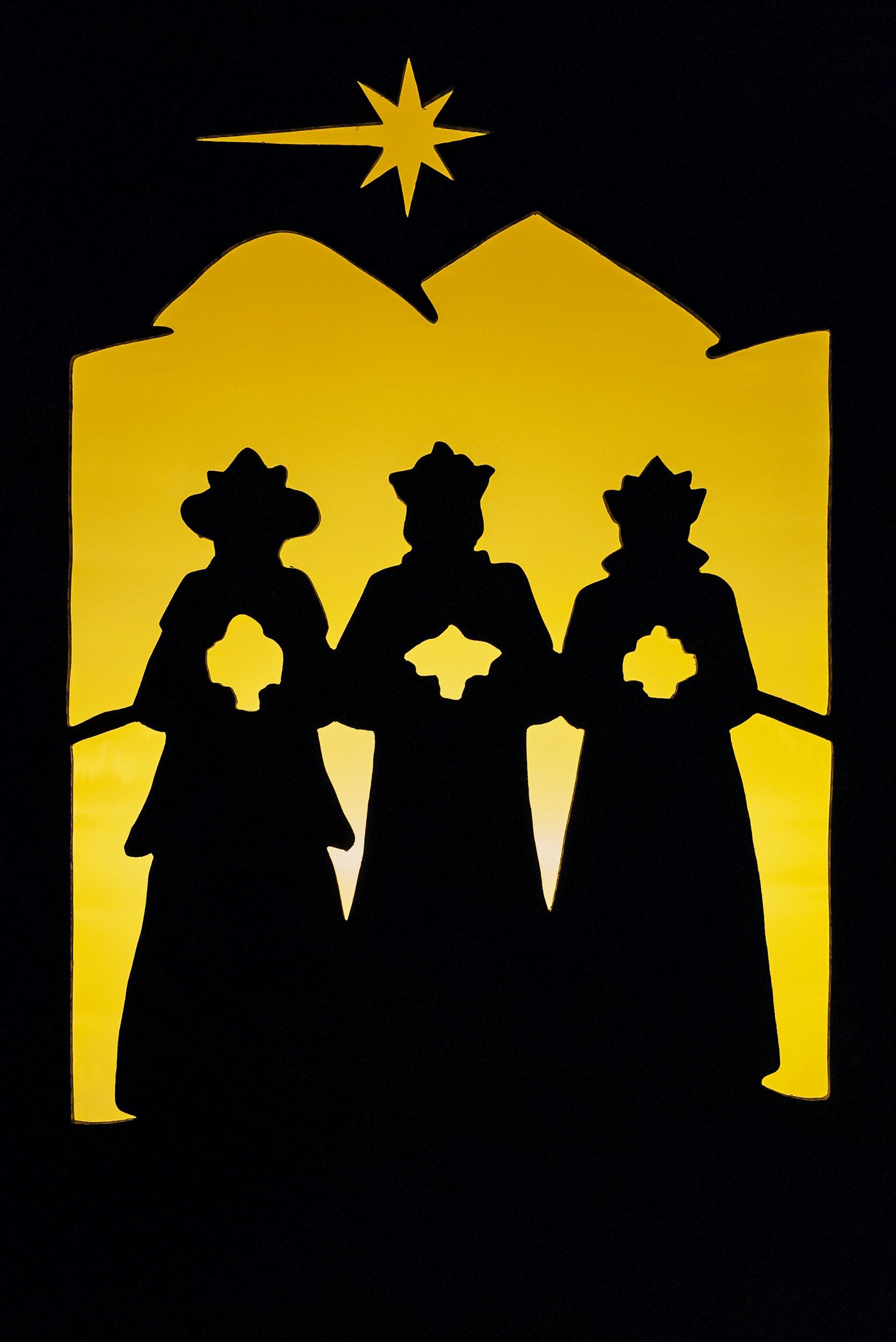
Strange Gifts, True King
This sermon was preached for the Epiphany of Our Lord on January 6, 2026.
Grace, mercy, and peace be with all of you from God our Father and from our Lord and Savior Jesus Christ. Amen.
A blessed Epiphany to all of you as we celebrate the culmination of the Christmas season. From this point forward, we no longer talk about Sundays in Christmas, but rather the Time after Epiphany.
We mark the occasion of Epiphany by telling the story most well associated with the Epiphany of Christ to the Gentiles. That's what the season of Epiphany is all about. It's the revealing of the light of Christ, not just to the Jewish people, but to the Gentiles, to the whole world.
We are all encompassed in this Word of God made flesh in Jesus Christ and given to us for the sake of the world.
The Wise Men's Journey
The wise men have come to bring a blessing to little Lord Jesus, a family in a poor province of the Roman Empire—somebody who would be of no account to anybody powerful or important in the world.
This baby was not found in the palace. Did you notice that the wise men get to the right area and the first thing they do is go to Jerusalem? The star led them there, yes. But when they get to Jerusalem, they're not searching the streets. They know where they're supposed to go. They're looking for the birth of this great king, so they go to the palace.
They talk to Herod, who of course is a little bit shocked and upset, to say the least.
This baby has been born who was laid to rest not in a cradle, but in a rough feed trough. So many strange things have happened since his birth.
Shepherds came and told stories of angels rejoicing in the hills over the birth of this one who will save his people, who is Emmanuel—God with us.
And now, this evening, have come these three strangers.
Who Were the Wise Men?
That there are three isn't necessarily the case. It's a tradition of the church, at least in the Western church, that there are three wise men. If you ask people how many wise men there are, they will always tell you three.
But nowhere in the story, in the Bible at least, does it tell you how many wise men came. There's more than one because it's plural. But other than that, we have no idea.
In fact, the Syriac church, the church that has a tradition in the Orthodox Eastern world to Syria, says that there were traditionally 12 wise men. But in the Western church, we say three.
In fact, legend has it that they even have names. This will be important later. Caspar, Melchor, and Baltazar. C-M-B.
The idea that there were just two or three wise men comes from the number of gifts that were presented—one king per gift. As if these men would have traveled by themselves, which of course is also fanciful.
Men of this importance, these magi—wise men, translated in English as magi, astrologers, or perhaps priests of a foreign religion—would not have traveled on their own. They would have traveled with a vast retinue to cross the desert from the faraway east. That's a pretty good sign that these men are wealthy, and they would not have traveled without servants and many provisions to accompany them.
Being from a distant land, they would have had strange clothing, strange customs, and strange language.
The Strange Magi
We say "wise men," but the word more likely ought to be magi. The word magi is very interesting. It comes from the old Persian word magus. That's why we think they're probably from Persia, from the area around modern-day Iran. But maybe points further east, maybe as far east as India.
It comes from the name for the Iranian priestly caste of the religion Zoroastrianism, which most people don't know anything about. In fact, I don't even know much about it. I know a little bit, but it's a very strange sort of local religion that is very dualistic. There's a good principle like a god and an evil principle in the world like a devil, and they are constantly at battle with each other.
The thing I'm most familiar with in Zoroastrianism is their unusual burial practices. They leave bodies to be consumed by vultures on the top of towers, and then they dispose of the bones later. They call that a "sky burial."
These are strange people. It's very strange to the Jewish people. In fact, they believe and practice things that the Jews would have found abhorrent, strange, foreign, and utterly unacceptable.
So they're not Jews. They're not even actually monotheists. They're dualists. They believe in two gods.
God's Revelation to the Gentiles
But still God has chosen to reveal something to them. God has given them wisdom in their art of astrology. This is what this priestly caste of followers of Zoroastrianism were known for in this time period. They were known for being astrologers who kept a very careful eye on the sky and who discerned what was happening in the world on the basis of the patterns that they found in the heavens.
That's why when this unusual star appears in the sky, they look up and see it and go, "Hold up, wait a minute, that wasn't there yesterday. We need to go check that out."
They recognized it as a sign that a great king has been born—a new star has appeared in the sky to their naked eyes. They had no telescopes. They had no lenses. Optics technology is still 1,500-1,600 years in the future. They're just looking with their naked eyes under the dark skies of Persia, of Iran.
They see a new star and say, "That means something." So they set off on a journey.
God has revealed something to them, even though they have no knowledge of the God of Israel, the one God. They have no idea what the prophecy would be of a newborn king who is the Messiah, the Lord, that he would come to save his people from their sins, that he would be a light to the whole world.
They just see what they've seen. And in the wisdom that God has given them, they set out to search and find its source.
The Gifts and Their Meaning
When they arrive, not only are their language and customs strange, but their gifts are strange as well.
A poor family might well make use of gold—money, it's good. But frankincense is a strange gift to give somebody in the best of circumstances. It's a gift suited more for use in a temple, not in a poor household. Maybe they could sell it and get some money that they could use to support themselves, but they would have no real use for incense in their home. That was not done among the Jews of the Ancient Near East in the first century.
And myrrh—that's a disturbing and altogether strange gift, because myrrh was used most often in their burial customs.
Maybe something was lost in translation, but I think more likely the traditional interpretation has some merit here. These gifts from these wise men who come not knowing really whom they are coming to pay homage to—but they are coming to worship this new king, to bear the goodwill perhaps of their own king in the far east to this new one who has been born.
The gifts they bring, which might have been ordinary gifts where they're coming from, mean something in Israel:
- Gold is a gift you give at the birth of a king.
- Frankincense is a gift you give to be used by a priest.
- Myrrh is used for embalming dead bodies.
(Happy baby shower? A little disturbing, isn't it?)
But here, these men who have no knowledge of the one true God have something that they can share of what is coming for this child. God has in his wisdom arranged circumstances so that the gifts that they bring will tell you and me something very important about this child who has been born under such strange circumstances.
He will be the great King of Kings and Lord of Lords. He will be our great High Priest, offering a great sacrifice to forgive us of our sins before God. And he will do so by becoming the sacrifice himself, dying and being entombed.
The Greater Message of Epiphany
This is a very common idea that's associated with Epiphany. In fact, I know it's one that I've preached in this church before. But there's something else I want to highlight tonight because their presence tells a more significant message. Here are representatives sent from God from among the Gentiles.
Everything else that happens in the birth of Jesus happens to Jewish people, among Jewish people, in keeping with Jewish customs and practices. Everything makes sense in a Jewish worldview. It all has its context drawn out of the prophecy of the Old Testament, fulfilling the law of the Torah.
And now here is something entirely different. Even at the birth of Christ, God sends emissaries from Gentiles who are so utterly different from the Jews as to just boggle the mind. For they come to offer gifts to a man who is also their king and their God.
Light for All People
The light of Christ has come. And it has not come just to the Jewish people, to them first, but to all of us.
All of us have received access to this wisdom. God has put a spark of his divine Word in each one of us, in the form of our conscience.
He reveals to us by his Holy Spirit, through the preaching of the Word, through the reception of his Word made flesh and given to you at the altar, that this One is not just for someone far off and far away and long ago.
This Christ who has been born is born for you—for the forgiveness of your sins, to bring you light in the midst of this present darkness, to give you the wisdom that you need to live before the Lord God who made you, who loves you, and saves you.
An Epiphany House Blessing
As we enter this new year, on this day of Epiphany, when we celebrate the Epiphany—the from-above revealing, epi-phanos, the from-above revealing of God to us by the light of a star—may you know the light of Christ and may it guide you daily.
I want to wrap up by telling you what I'm sending you home with tonight. I'm giving everybody a "cigarette." Okay, it's not really a cigarette, and I'm not sending you home with this one. It's a piece of chalk. But it looks like a cigarette to all the world, doesn't it? Makes a great prop!
I'm sending you home with a piece of chalk and this little greeting card-shaped thing. It's an Epiphany house blessing.
It explains that the letters C, M, and B are the traditional first initials of Caspar, Melchior (or Melchor), and Balthazar—the three kings from the east who supposedly came and brought gifts to Jesus.
But C, M, B, now in these latter days—we're still talking Latin here—can also stand for Christus mansionem benedicat, Latin for "May Christ bless this house."
For many centuries, it has been a tradition on Epiphany to use a piece of chalk to write on or above the door that you most frequently go in and out of. So like me—I might put it on my front door, but I come in and out of the back door of my house more often as I'm walking over to church. I'm going to put it there.
What you do is you write 20 + C + M + B + 26. You chalk that on your door.
Not because it has magic power. Not because this is special holy chalk. "Pastor gave it to me. It must be special." Nope. I bought this at Ace Hardware today.
But because it is a reminder that we are seeking God's blessing in 2026. That we want him to be Lord, not just of our lives on Sunday mornings or Saturday nights or Tuesday nights, but we want him to be Lord of all of our doings and all of our lives.
I'd encourage you—not required—but we'll be distributing these tonight. Take this home and use it with the prayer that I've written for you to accompany it. Chalk your door or your door frame and use that as a reminder that God has brought light to you and brought wisdom.
May it be a prayer for you that the Lord God guide you with his wisdom and light this year.
And now may you receive the peace of God which surpasses all understanding and may it guide you and guard your hearts and minds in Christ Jesus our Lord, to life everlasting. Amen.