Walking Humbly with God
This sermon was preached by Pastor Ted Carnahan for the Fourth Sunday after Epiphany, on Sunday, February 1, 2026.
Grace, mercy, and peace be with all of you from God our Father and from our Lord and Savior Jesus Christ. Amen.
There is a question in our first reading today from Micah chapter 6. That question is: how do I have the right relationship with a holy God?
It is asked:
"What shall I come before the Lord and bow myself before God on high? Shall I come before him with burnt offerings, with calves a year old?"
That sounds pretty good. That's what the Old Testament said he was supposed to do.
"Will the Lord be pleased with thousands of rams, with 10,000 rivers of oil?"
Now we're seeing that there's a problem. 10,000 rivers of oil?
And then it gets even worse:
"Shall I give my firstborn for my transgression, the fruit of my body for the sin of my soul?"
Now we see the crux of the matter. This is a man who is experiencing the weight of sin and knows that nothing that he could offer a holy God is enough to justify himself.
The response comes immediately after:
"He has told you, O mortal, what is good. And what does the Lord require of you but to do justice, and love kindness, and to walk humbly with your God?"
This is such an important verse—this last one that you find. It is actually quite famous. My own grandfather—this was his favorite Bible verse: "What does the Lord require of you but to do justice and love kindness and walk humbly with your God?"
But what does that mean? What does that look like in practice? How is it that we should put these things into play?
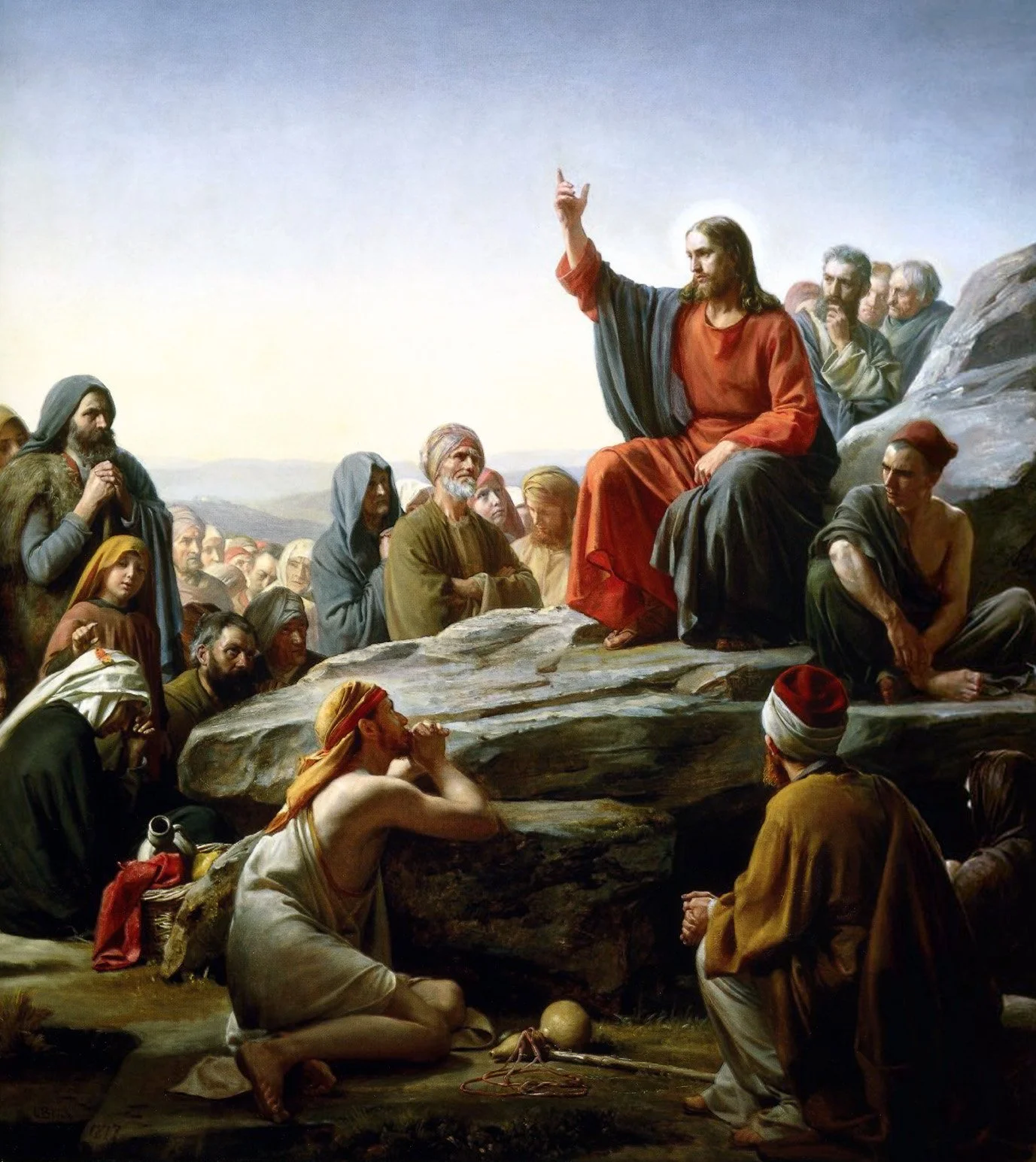
Jesus' Sermon on the Mount
Jesus gives us that at the opening of his Sermon on the Mount. Matthew chapters 5, 6, and 7 comprise the teaching of Jesus distilled down into what is recorded today as the Sermon on the Mount. Luke calls it the Sermon on the Plain. It is the same sermon, with different emphases in what was remembered and written down for us.
These first few verses are called the Beatitudes. They are not "bee-attitudes" because this is how bees are supposed to act and feel about the world. No. It comes from a Latin word, of course. "Beatitudes" comes from the Latin Vulgate translation of the Greek New Testament. The word beati means "blessed." And so, "blessed," the "blesseds" gets turned into the "Beatitudes."
What Does "Blessed" Mean?
The blessings that Jesus proclaims here come to our ears in a strange way. They are strange to us because they are not the kinds of blessings that the world offers.
What does it mean to be blessed? Even today, the word "blessed" gets thrown around. If somebody says to you, "How are you doing today?" and you answer, "Well, I'm blessed," what do they even mean by that? They could mean that they are having a good day and they are feeling good. They could mean that something great has happened to them. They have come into possession of some money they did not expect. They could mean all sorts of things by "blessed."
The word "blessed," translated for us as "blessed" here, means to be fortunate. I do not like that as a translation. Some new Bible translations try to use "fortunate," but the word in English "fortunate" comes from the Roman goddess Fortuna, who is the goddess of wealth. I am not a big fan of using that word here because it imports another god's worship.
But this challenges us because to say "blessed" is a very worldly word. "Blessed" in this sense or "fortunate" in this sense is talking about something worldly: "Wealthy are they! Fortunate are they! Blessed are they who do these things, who are these ways."
A Survey of the Beatitudes
The problem with the Beatitudes is that each one of these short verses is such condensed, beautiful, succinct teaching of Jesus. Yet it would be possible to preach at least one sermon on each one of them!
I decided I would preach 15 minutes on each verse, and we should be done by about lunchtime. (No, obviously not.) At the same time, I do not feel like I can skip any of them and say, "Well, this is the one that we need now," because we need all of these now.
Instead, I am going to give you a survey of them and some commentary on them. Hopefully, we acknowledge both our own need for God—as the man, the prophet, comes to God in Micah 6 and says, "How shall I find a right relationship with God? How shall I be forgiven my sin?"—and also discover how it is that God calls us to live.
1. Poor in Spirit
Jesus starts first by saying, "Blessed are the poor in spirit."
Interestingly, when St. Luke records this teaching, he just has "Blessed are the poor." Here Matthew wants to emphasize that what Jesus was talking about here is a spiritual poverty. Those who are poor in spirit — has to do with the disposition of our own spirit.
Obviously, the man being quoted—whether it is Micah the prophet himself or someone else that he is quoting there—is running into this poor-in-spirit attitude. He is in a position of humble dependence. There is nothing that he can do to improve his lot without God.
So Jesus starts off by saying those who recognize that, in the grand scheme of things, they really do lack power and status and security—that they recognize they are dependent upon a holy God who gives and takes as he decides, and not how you decide: this is whom we must worship and trust.
We must trust God rather than worldly things. The world does not care for your faith in Jesus Christ. The world would call you away to other loves. But here, the Lord tells us that we must depend solely upon God.
2. Those Who Mourn
Well, when we come into contact with a holy God, we discover very quickly that we are sinners and we need a Savior.
That starts us into the next Beatitude: "Blessed are those who mourn."
What mourning is he speaking of here? Mourning our sins. Mourning that we are sinners who need a Savior. Mourning that our spirits are turned against the holy, loving God who made us—that we are in rebellion against our Creator.
Jesus tells us those who mourn will be comforted, just as the end of weeping and mourning comes when mourning comes to an end. So will our own weeping over our sin come to an end when we receive the comfort of the forgiveness of sins.
Here now we have set ourselves on the path of the Christian life: poor in spirit, depending on God; mourning our sins and then being comforted by the grace of the Gospel.
3. The Meek
Then Jesus continues: "Blessed are the meek."
This is the most misunderstood part of the Beatitudes. Sometimes we take the word "meek" and we think that it means weak. But no, the meek are simply those who choose not to be forward, to not impose upon the people around them.
Meekness is not weakness, but rather strength under control. Instead of being forward, instead of striving after things that we need as if the only way that we are going to receive them is if we go out and get them at the expense of others—to be meek is to be humble and trusting, knowing that God will provide for us what it is that we need.
4. Hungering for Righteousness
But as we go out into the world with this meek spirit—not imposing our will on others, but instead conducting ourselves with strength in ourselves—we will discover that the world is not as it ought to be. We will begin to hunger and thirst for righteousness.
Jesus says those who hunger and thirst for righteousness are blessed because they will be filled.
Now having been provided what we need, we will desire greater righteousness. We will look out at the world and say, "This world is in captivity to sin and cannot free itself. Lord Jesus, come and set things right."
We should hunger for righteousness in the world around us. We should thirst for it. We should want it desperately, knowing that the perfect fulfillment of these desires will not come by our own hands, but will come when Jesus Christ returns to earth.
5. The Merciful
Also, as we live in community and in society, hungering and thirsting for righteousness—rather than using that as a cudgel to bludgeon people who have not attained the same walk with Christ—we are to be merciful: "Blessed are the merciful, for they will be shown mercy."
Here is not simply withholding a hand of rebuke or withholding punishment to those who deserve it, but actual active kindness. Not just avoiding being harsh, but actively helping the people around us.
We are to be benevolent and generous, especially to those who cannot help themselves, to the poor, to the vulnerable. We are to be merciful and help.
6. Pure in Heart
It is easy for us then, in our benevolence in these good works that we do, to think that finally we have achieved what it is to be righteous—we are good in and of ourselves.
So then Jesus gives us the next Beatitude: "Blessed are the pure in heart."
We lose the benefit of mercy unless we remain uncorrupted by it—not boasting of our good works, but instead continuing to point not at our own goodness, but at the goodness of the God who saves us and calls us to follow him.
7. Peacemakers
We are reconciled not just to God, but reconciled to ourselves. And therefore Jesus says, "Blessed are the peacemakers."
Because as peacemakers we have an opportunity to bear the peace which God has given us—peace with God through the person and work of Jesus Christ. We get to take that peace and share it with the people around us. We get to give them a measure of God's peace and be reconciled to them as we have been reconciled to God.
8. Persecuted for Righteousness
But this does not come without a price because the world does not reward those who are meek and merciful. The world does not regard those well who hunger and thirst for righteousness because the world loves its unrighteousness.
The world does not reward those who are pure in heart and peacemakers, but rather rewards those who are willing to do whatever it takes to get ahead and to take what is theirs or what they believe is theirs.
And so consequently Jesus tells us: "Blessed are those who are persecuted for the sake of righteousness."
- You will be rejected for the sake of your virtue.
- You will be rejected for the sake of your defense of others.
- You will be rejected for your piety and worship of God.
- You will be rejected for the sake of the goodness that God has given you.
But you should not regard this rejection simply as a sign that maybe you did something wrong, but rather as a sign that the world itself has been turned upside down and sees the good things which God has given us as evil.
9. When People Reject You
These Beatitudes are not without their risks. Following Jesus Christ is not the safest road, but it is the most faithful.
He gives us a warning and a promise: "Blessed are you when people insult you or persecute you or lie about you because of me. Rejoice and be glad, for that is how their ancestors treated the prophets."
We will rejoice and be glad for our Lord has given us a perfect way, a perfect road to follow—one which puts us in our proper relation to God, which puts us in a position of dependence upon Christ and his word rather than the approval of this world.
We will tell the truth even when it costs us because Christ told the truth and it cost him his life.
God's foolishness and weakness
Finally, I would like to leave you with a reflection on 1 Corinthians 1. St. Paul writes:
For the message about the cross is foolishness to those who are perishing, but to us who are being saved it is the power of God. For it is written, “I will destroy the wisdom of the wise, and the discernment of the discerning I will thwart.” ... For Jews demand signs and Greeks desire wisdom, but we proclaim Christ crucified, a stumbling block to Jews and foolishness to Gentiles, but to those who are the called, both Jews and Greeks, Christ the power of God and the wisdom of God. For God’s foolishness is wiser than human wisdom, and God’s weakness is stronger than human strength.
May you live in the foolishness and weakness of God. May you hear what the world regards as nothing and count it as valuable for everything.
And this, when it gives you peace—may the peace of God which surpasses all understanding keep your hearts and minds strong in Christ Jesus our Lord to life everlasting. Amen.