The Reversals of Grace
This sermon was preached by Pastor Ted Carnahan for the Fourth Sunday in Lent, March 15, 2026.
Grace, mercy, and peace be with all of you from God our Father and from our Lord and Savior Jesus Christ. Amen.
The story of Jesus healing the man born blind is a difficult one to preach. For one thing, you might have noticed it was 41 verses long, and yet there's no good place to cut the story down to make it shorter, to make it a little bit more manageable.
And at the same time, there is so much that can be said. When I'm faced with a situation where I have a lot of different things that I could say, I could either say all of them, (but I don't have that much time on the radio this morning) or I can bring it down to a couple of key points that stood out to me this week as I was preparing my sermon.
Key Reversals in the Story
So I first want to point out that this whole story is based in the idea of reversals. The way that we expect the world to work versus the way that it actually does work.
There's a reversal here between the expectation of the Pharisees and sort of contemporary culture in Jesus's day and the reality that we see.
For instance, this man who was born blind is assumed to have done either himself done something wrong or more likely his parents did something wrong. And the fact that he was born blind is punishment from God because of their sin.
And so there's a reversal there because that's not really what's going on, and Jesus actually says that this was done for God's glory.
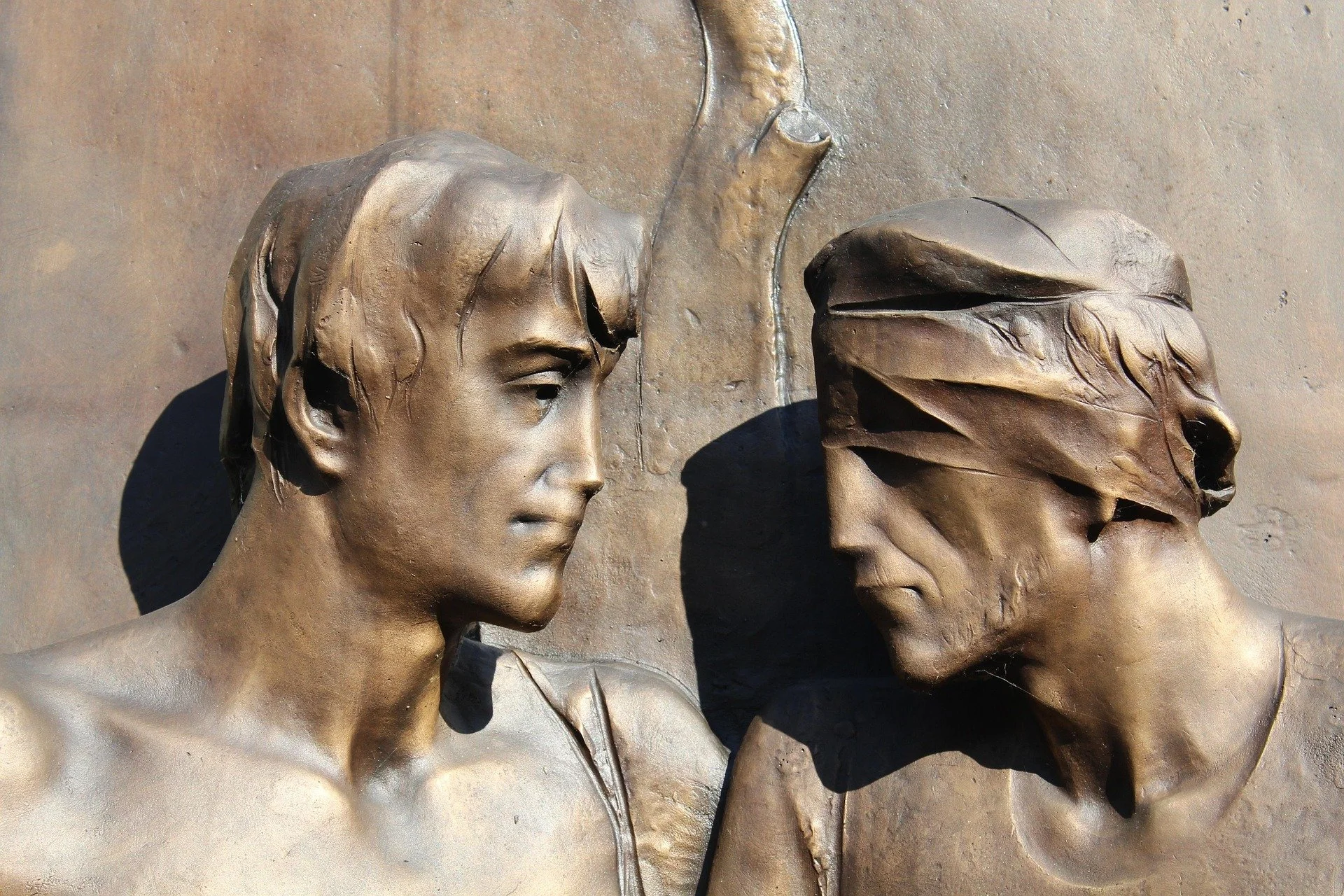
There's a reversal between the man who was blind and now sees and the Pharisees who imagine themselves to be very clear visioned and careful studiers of the scriptures, where the man who was born blind now sees the things of God and the experts in the Law are the ones who are blind.
But there are other reversals. And one that I want to point out is the reversal of the order of operations that we usually think of when we think of God's interaction with humankind.
Notice here today, if you were put in the shoes of the man who was born blind, you didn't see Jesus. You heard him first. Imagine you are blind: groping around, maybe with a cane to feel your way along, doing the best you can to live your life in predictable ways. Setting things down in the same place so that you know where to pick them up. As people with reduced vision have done since time immemorial. Making their way in the world as best they can.
And you hear a man walking down the street amongst a group of men. Another rabbi is in town. And you don't know who he is. Maybe you've never even heard the name of Jesus. It certainly seems like this man doesn't know who Jesus is. But he has heard something that he thinks is quite familiar. Because he has been used as an object lesson in preaching before.
And so this man's disciples, this rabbi's followers, ask him, "Who sinned, himself or his parents, that this man was born blind?"
Here we go again, he thinks to himself. Being used as an object lesson for something that I didn't do. But notice that as he hears the disciples ask that question — and this question, frankly, is fairly innocent. It's grounded in wrong ideas, but it is certainly part of what they grew up hearing.
Jesus then speaks first to them and says, "Neither this man nor his parents sinned, but rather he was born blind so that the works of God may be demonstrated through him."
This man did not see Jesus first, but first heard gracious words from his mouth, reversing the expectations that culture has had about what blindness is. And he said this is not an example of God's punishment to make it his fault, but rather it is for God to demonstrate his grace.
If we want to see clearly, though, first we do not see the word of God, but rather we hear it. We need ears open to hear the word of God. Too often in churches and in other places, we have this idea that what Christianity is, is first we must believe and obey, and then we will find our healing and peace.
But here things are entirely reversed. This man has made no confession of his faith. He has made no particular statement of his belief. He is merely going about his daily tasks. And Jesus is the one who first comes to heal, and then, having revealed who he truly is, this man comes to believe and obey.
The Power of a Transformed Life
There really are no good arguments against the reality of a transformed life. As I was a student in high school and was fairly well convinced that God was not real, I encountered a man through being invited to a high school youth group as a senior in high school. I was invited by a girl that I wanted to date, and she said, if you want to date me, you have to come to my youth group, which I will continue to say, ladies, is a fantastic way to engage in evangelism!
And the man who was the guest speaker that night was very obviously somebody from a rough background. It was easy to make assumptions about him, just like the disciples made assumptions about this man born blind. He had tattoos all over his body, and they're not pretty ones — they were gang tattoos. And he told a story. Just in his very person, he told a story, and while he was covered in tattoos that made me think that he was a pretty rough character, he also was wearing a button-down shirt and tie.
And he told a story. And the story was of him working the night shift with his co-worker, who was a Christian. And he decided that night that he was going to rob his co-worker at knife point as they were unloading trucks. But as he pulled out his knife to rob his co-worker, God dropped him to his knees like a bolt from the blue.
And the co-worker, being a Christian and recognizing that God was having his way, used it as an opportunity to share the gospel with this young man. And he heard first and clearly that God forgives him his sins, and he was healed. And he became a follower of Jesus.
I had a lot of intellectual ideas about why God's existence couldn't be proved. I thought I was pretty smart, but I couldn't make one argument against this young man standing in front of us with his tattoos and his tie.
There is no good argument against the reality of a transformed life. Jesus healed him and then invited him to follow. So that's our first observation.
Jesus Seeks Us First
The second observation here is that we get the reversal of the order of operations wrong so often. We think first that we must seek Jesus before finally Jesus finds us. This is completely backwards and we see it in our story today.
The man doesn't seek out Jesus. He's going about his daily life. Jesus finds him. This starts with this question, "Who sinned that this man was born blind?" And then Jesus says neither, and he was born blind for this day, for this moment, because God is coming into this man's life to bring his healing and peace.
It is easy for us to imagine that every bad thing that happens to us is a punishment from God. And in some sense, that is true that the brokenness of creation and fallenness of humanity, the sinfulness of our nature, well, that causes problems.
Sometimes the things that happen to you are because you made dumb decisions or sinned against God. But many of the things that happen to you are not because of something that we have done wrong. And yet God can make use of those.
The bad things that happen to us, the way that we suffer in this world can be so that God's power may be perfect in our weakness.
I've told the story before, but I'm reminded of when I myself was diagnosed with an autoimmune disease called myasthenia gravis. And fortunately today I'm entirely free of all the symptoms of that. But for a long time, I thought I was in serious trouble. It was a serious illness and many people suffer with it. It literally means that that phrase "myasthenia gravis" means grave muscle weakness.
And I thought for a while, perhaps it is something that I did to earn this. But then I remembered what Jesus said to St. Paul when he prayed that the thorn in his flesh might be removed. He said, "My power is made perfect in your weakness."
We are sought out by Jesus long before we seek Jesus. He is, as has been said in poetry, "the hound of heaven" who pursues us.
The Blindness of Self-Reliance
Finally, the third thing I wanted to observe today is that those who think that they see the hidden things of God are clearly blind. But those who know that they can't understand God's hidden work in the world are the ones who truly see.
There's a reversal going on here that I just find delicious: The Pharisees think that they understand God's work, and they are great expositors of the scriptures. They have studied God's word in great detail.
But nevertheless, just knowing the Bible has not made them followers of God.
They have become blind because they cannot see the truth that undergirds all of Jesus' ministry: Jesus is the Messiah, and therefore, he is the Lord of the Sabbath. He is truly God's son. And without that faith, their blindness means that they get everything going on in this story backwards.
Because they do not understand who Jesus is, everything that happens here, they totally miss it:
- So Jesus is healing on the Sabbath, which would be a terrible violation of the Sabbath if it were not for the fact that Jesus is the one who created the Sabbath because he is the Son of God.
- Jesus is a sinner because he's saying, committing blasphemy, saying that he is the Messiah and the Son of God and the Son of Man. Except that it's not blasphemy because he actually is the Son of God and the Son of Man. The logic here is entirely backwards. If they understood who Jesus is, they would be able to validate what Jesus does.
- And it keeps going: The man born blind is a sinner who somehow deserved to be born blind, which is sort of amazing. Who sinned? This man who came from the womb, unable to see — I mean, that doesn't even make any sense — or that this man who was cured was cured on the Sabbath and therefore he should not have been cured because it's illegal to do works of healing like that on the Sabbath. How is it that we blame those who have found their peace in Christ?
And yet, as educated as these men are, these Pharisees who are challenging Jesus' authority to say and do these things, and then becoming so blind, here comes this man who has been born blind and he speaks so boldly!
His parents are afraid to be put out of the synagogue because they're afraid to confess that Jesus may actually be the Messiah. But this man is bold and he steps forward and he says,
"Here is an amazing thing, an astonishing thing. You do not know where he comes from and yet he opened my eyes. We know that God does not listen to sinners, but he does listen to one who worships him and obeys his will. Never since the world began has it been heard that anyone opened the eyes of a person born blind. If this man were not from God, he could do nothing."
He confesses Christ boldly, though he does not even know that Jesus is the Son of Man, as we find out a few verses later. And he's willing to bear the penalty of correction and even being thrown out of the synagogue for his confession of Christ.
Conclusion and Application
Here we find the world as God has designed it to be.
- Jesus seeks us out first with his Word.
- Then Jesus heals us of our sin and our doubt apart from our merit.
- And then he sends us to testify about what we have seen and heard.
But if we never hear his word, we will be far from salvation. If we never come to Jesus with our sin and our doubts, we will never be healed of them. If we never share what God has done in our lives, others will not hear the word and know the grace of God.
And so in this season of Lent, may we redouble our efforts at the disciplines of Lent and open our eyes. Because our loving, gracious Savior stands ready to forgive us, to heal us, to restore us. The world around us, shrouded in darkness, stands in need of Christ's light.
May you know the light, that light which penetrates into the dark places in your soul, bringing forgiveness and correction, healing and grace. And may the peace of God, which surpasses all understanding, keep your hearts and minds strong in Christ Jesus our Lord, to life everlasting. Amen.