
Mercy in Spirit and Truth
This sermon was preached by Pastor Ted Carnahan for the Third Sunday in Lent, March 8, 2026.
Grace, mercy, and peace be with all of you from God our Father and from our Lord and Savior Jesus Christ. Amen.
Jesus is on the move and he reaches a Samaritan city. He is near the plot of ground where Jacob had given his son Joseph some land and Jacob's well was there. Jacob dug the well himself. Remember: Jacob's other name is Israel. When we talk about the God of the Old Testament, we talk about the God of Abraham, Isaac, and Jacob.
This is a significant historic spot. The people who go to get water there remember their connection to their ancestry, to Jacob, their patriarch. Yet there's something a little different about this city because it is a city of the Samaritans, not a city of the Jews.
Who Are the Samaritans?
Who are these people, the Samaritans? The Samaritans are not exactly what I would call rivals to the Jews, but they're definitely a different group of people who come from the same stock.
You have to remember your Old Testament history here. The Jewish people settle in Canaan. You have the 12 tribes and they all get their own territory. You have the rise of the kings of Israel and then the kingdom splits in half.
You have the northern kingdom, which gets called Israel, the 10 tribes. Then you have the southern kingdom, which is called Judah, which is the two tribes, Judah and Benjamin in the south. They go their own ways.
Both of them have good kings and bad kings, faithful kings who follow the Lord God of Israel and unfaithful kings who lead them astray. But things are far worse in the north, where the northern tribes go in their own way and worship false gods.
Eventually God judges them and destroys them. He destroys them by sending the Assyrian empire in to conquer them.
When the Assyrians come in, not only do they conquer them and they haul some of the people off into their own separate Assyrian exile, but more prominently, they also resettle multiple nations of people into the northern kingdoms.
The idea here is to dilute their culture, their history, and their religion by bringing in outside forces and settling them there. They bring in folks from: Babylon, Cuthah, Avva, Hamath, and Sepharvaim.
We know this because 2 Kings 17 talks about the Assyrians blending people into the northern kingdom. We also know that this is a sign of God's judgment because each of these people bring their own worship, their own religion, and importantly, their own false gods to the area.
The land has become, in the north, polluted by the worship of these idols. This continues for a long time.
Judah persists for a while, but then Judah undergoes its own judgment. You have the Babylonian exile, etc.
Jesus Enters Samaria
Now, Jesus, the Messiah, the Son of God, has come to Samaria, to the Samaritan city of Sychar. Here are these Samaritans who trace their lineage back, especially to the tribes of Ephraim and Manasseh, and in general to the remnants of the northern kingdom of Israel.
But he is not among people who are Jews. The Jews and the Samaritans fight like cats and dogs.
The reason we have Jesus, for example, telling us the parable of the Good Samaritan is not because 'Good Samaritan' is a term that applies to a good person, but it would be like us saying 'the good member of ISIS'. We hate those people, but here's an example of a good one!
Samaritans and Jews don't get along. Everybody knows it. They have different ideas about worship. But the interesting thing is that they share religious texts in common. The Samaritans have a version of the Torah, the first five books of the Bible. It was corrupted a little bit over time, but a lot of things remain the same.
One of the big differences, though, is in where worship was to be held. Mount Gerizim would be the Samaritans' answer, but the Jews say at the temple in Jerusalem.
Both of them have the Torah, although the Samaritan version got corrupted. Both of them trace their ancestry to Abraham, Isaac, and Jacob. They are like siblings who don't get along.
Interestingly, both groups still exist today. Obviously, we know the Jews are settled in the land of Israel, but also there have been Samaritans in that land since ancient times, and they're still there today. Not a whole lot of them, but they do still exist. There are Samaritans.
That gives us a little background for understanding what's going on as Jesus comes to this Samaritan city. He's an outsider, and he settles by the well, hoping that he can get a drink.
But of course, when you have a public utility like a well, you don't just hang a bucket there. Buckets are expensive. Buckets are valuable. They require a cooper to make them, and buckets are not an easy thing to come by.
You don't just leave a public communal bucket. It'll get stolen. So when you come to the well, you have to bring your own bucket, and Jesus isn't walking around Galilee with a bucket.
He waits for somebody to bring a bucket to draw water, and asks politely for a drink.
The Conversation at the Well
They get around to this idea where Jesus says, or first of all, the woman wants to know, "How is it that you, a Jew, ask a drink of me, a woman of Samaria?"
Two strikes against her as far as the Jewish people would be concerned. First, a woman, and he should not have contact with a woman who is not in his family, but also a woman of Samaria. Now we're asking for drinks from hated others.
He answers her that, "if you knew who I was, you would be asking me for a drink of living water."
Just like the encounter between Nicodemus and Jesus in John chapter 3, here in John chapter 4, we're talking on two different levels. Jesus is speaking of the spiritual, and the people he's talking to are very focused on the physical and the material.
She says, "How are you going to draw water from the well to give me a drink of living water, whatever the heck that is? You don't have a bucket. That's why you're sitting here waiting. Are you greater than our ancestor Jacob, who gave us this well?"
Well, yeah, actually he is. Think about who Jesus actually is. He is the Son of God, incarnate. He's the Messiah. He is the King who has come to liberate his people, and not just the Jewish people, but all people, which is why he is having this encounter with this Samaritan woman at a well.
Jesus decides to take the conversation from the material — yeah, no, I don't have a bucket, but that's also not what I was talking about — to the spiritual.
He says, "Everyone who drinks of this water will be thirsty again, but those who drink of the water that I will give them will have eternal life."
Then he eventually comes around to saying, "Go get your husband."
Here's the other part that we don't necessarily understand, because he says, "Go get your husband." She says, "I have no husband." He says, "You're right in saying you have no husband. You have had five husbands, and the one you have now is not your husband. What you have said is true."
Traditionally, then, people take this story and they say, this is an example that Jesus knew something about this woman, that she was, I don't know, somehow promiscuous, or maybe, you know, if she's not at fault for this, she has been married and divorced, or married and her husbands have died, and gone through multiple husbands, and now she is living with a man who is not her husband, and maybe she's some sort of notorious sinner.
I don't think that's what's going on in this story. I think this story is actually intended sort of as a parable. It's intended to pull us back into something else that's going on.
Deeper Spiritual Layers
Remember, I said to you that there were these other peoples who were resettled in northern Israel. The word in Hebrew and Aramaic for "husband" is Baal, which also happens to be the word for master, and a common name that is used for false gods.
Again, we're not speaking just on the level of her husband, but we are speaking on the level of the husband — the Masters — the Baals of the Samaritans! They have fallen into false worship, and they have had not one husband, but five husbands — five Baals — five false gods that the Samaritan people have been worshiping!
Remember, the Assyrians brought in the Babylonians, the Kuthah, the Avvas, the Hamaths, and the Sepharvaim, five outsiders with their false gods.
This is working at multiple levels! Yes, you have had your own checkered history, but your people have a checkered history, and that is what Jesus is there to confront and overcome.
"Woman, the time is coming when you won't worship on this mountain, nor in Jerusalem." The differences between the people of Israel and the people of Samaria will no longer matter because true people who worship the one God, the God we have in common, will worship in spirit and in truth.
It will no longer be about keeping the peculiarities of the law, whether that law says to worship in the temple at Jerusalem with the high priest there, or to worship on the mountaintop of Mount Gerizim.
True worshipers will worship in spirit and truth. That is, they will worship not by their sacrifices and offerings, nor by their good works, but by faith and trust in Jesus Christ himself.
Which is why he can point to himself at the side of this well this day and say, if you knew who I am you would ask me for living water and it would bubble up inside you, a spring of water to eternal life.
This living water is a gift given by the Holy Spirit, not literal water, but a metaphor for the way that life bubbles up in the lives of those who put their faith and trust in Jesus Christ, and also an image intended to remind us and to drive us to the font of Holy Baptism.
Faith and Messianic Expectation
It is at that time then, that this Samaritan woman, whose name is not even recorded in the story, reveals her faith. Her messianic expectation.
She stops and says, you can almost imagine it in a secretive voice, "I know that Messiah is coming, who is called Christ. When he comes, he will proclaim all things to us."
Do not harden your heart against the Lord God who comes to proclaim all things to you. He comes to bear his Law and his Gospel, to give you his commandment and to show you that you have failed to keep it.
Do not be like the people of Israel in the wilderness, in the Wilderness of Sin, who with their quarreling and testing of God revealed their faithlessness.
Pay attention to what happened in that first reading today. The people of Israel are quarreling because they have been brought out into the wilderness, and even though God has demonstrated through his prophet Moses tremendous works of power, still the people quarrel.
I like to sometimes call these folks the Return to Egypt Committee, because they get together after seeing all of the amazing things that God has done to bring them out of slavery, and in towards the promised land, and they say, "You know what, but things were a little easier back in Egypt. I'd rather go back there."
Do not harden your hearts. That's what Massah and Meribah mean. Massah and Meribah mean "quarreling" and "testing."
Even after Moses strikes the rock with his staff, the same staff that opened the way for them to pass through the Red Sea, and gives them water springing up from the rock, they quarrel and test the Lord, and they don't believe his promises.
Rather, believe that the one who has come to you has come to you at the well, despite your rebellious soul, despite the fact that you have had other husbands, other Baals, false gods whom your heart has gone after. Believe that Jesus Christ has come to proclaim to you, "I am he, the one of whom you are seeking and expecting."
Believe that he has come to you in his mercy to give himself to die for you on the cross, not because you are godly already, but because you admit that you are ungodly, as St. Paul says, "at the right time Christ died for the ungodly."
People like you, who are not perfectly faithful, who quarrel and test the Lord, who disbelieve his Word, who forget his promises, even those who have made themselves enemies of God. Hated outsiders like Samaritans, you have been welcomed into the grace of God anyway.
Call to Repentance and Peace
Now is the time for you to repent and turn back to the Lord your God, knowing that he welcomes you and calls you with streams of living water flowing forth from his heart to give you what you cannot get yourself, no matter what well you lay claim to or what bucket you think you can draw with.
You who are far off have been brought near. You who were lost have been found.
You now can boast, not in your own righteousness, but that of Jesus Christ, in whom you have salvation and deliverance.
May you trust the peace that can come only from our Lord Jesus Christ. May that peace, which is the peace of God, which surpasses all understanding, be strong in Christ Jesus our Lord to life everlasting. Amen.
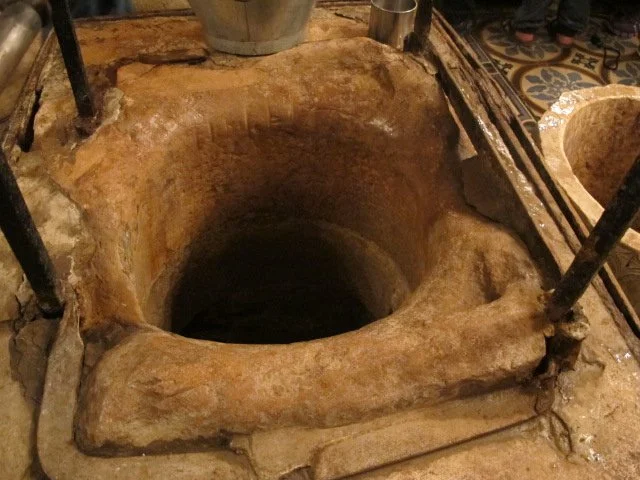
A modern-day photo of the well believed to be Jacob’s well in Nablus.
