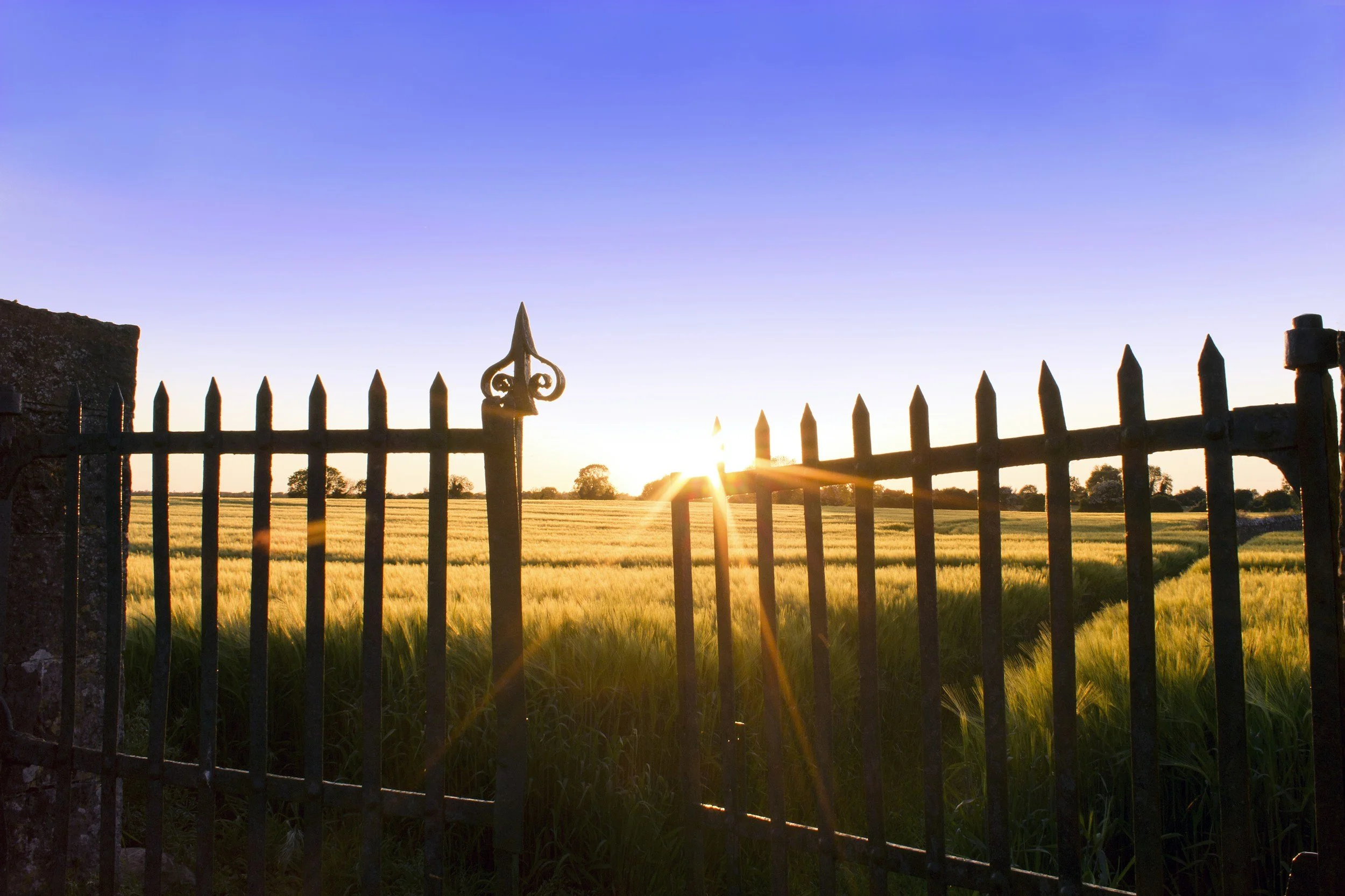
Jesus the Gate
This sermon was preached by Pastor Ted Carnahan for the Fourth Sunday of Easter, Good Shepherd Sunday, on April 28, 2026.
Grace, mercy, and peace be with all of you from God our Father and from our Lord and Savior Jesus Christ. Amen.
This weekend is informally called Good Shepherd Sunday because of its focus on God being our shepherd and providing for all our needs.
But interestingly, if you were paying attention to our gospel lesson today, the appointed reading for the Holy Gospel does not compare Jesus to a shepherd at all in the second half.
It starts off by saying Jesus is a shepherd, and then it says that the people don't understand what he's trying to say. Instead, he restates it. He goes at it a different direction. And he says, "I am the gate for the sheep."
Jesus has gone from "shepherd," which is a familiar image for us to understand. Jesus leading his sheep and protecting his sheep.
And then he's gone from that. Now he's not even the shepherd. He's not the gatekeeper. He's not even a person opening and closing the gate and making sure only the right people come in. Jesus has reduced himself to the inanimate object of a gate. He says, "I am the gate for the sheep."
What's going on here? Why is Jesus telling us that he is the gate?
The Exclusive Claim of Christ
Well, I think first of all, he's making an exclusive claim. He's saying that "I am the gate for the sheep."
In other words, that the sheep can only come in through the one door, which is Christ. There is no other gate. There is no other way of salvation. There is no other door.
He says, "I am the gate for the sheep. I am the path, the one way by which sheep may safely enter and leave the sheepfold."
Now we oftentimes imagine shepherds being a lot like what Western shepherds were like, which is to say that they would travel to a particular field and pasture their sheep in a particular field and kind of keep watch over it.
And if they needed to herd the sheep together, they would coerce them or coax them to get them together and move them using shepherd dogs.
That's not usually the way that the people of the ancient Near East shepherded sheep. Oftentimes they would travel. They would not have just one pasture, but they would go from field to field and kind of move along the day.
And as they did so, the shepherd would oftentimes sing. And the sheep knew that the shepherd was the one to follow. So much so that you could put at night, the sheep could be gathered into a sheepfold, into a walled off, often stone walled pen with one gate and multiple flocks would be clustered together inside that one place.
And you'd think, what a disaster, what a nightmare. How do we sort the sheep? How do we make the right ones go with the right person? But often it was as simple as the sheep hearing the shepherd's voice and calling them out, and they knew which one to follow.
Here, Jesus is making a claim that he is the true and good shepherd, that the sheep know his voice, that he is the one they must follow.
But he's also saying that he is the gate.
Ancient Sheepfolds and Protection
Now these sheepfolds would be a stone enclosure. Oftentimes they were up against a rocky outcrop so you wouldn't have to build a stone wall all the way around them. They were oftentimes down in a depression where they were sheltered from the weather and cut out of the wind a little bit. It was a nice, warm, cozy place to cram a whole bunch of sheep together to keep them warm and safe through a dark night.
But if you're a shepherd, those sheep are valuable to you. And the last thing you want is a lion or a bear to come and start eating your sheep. After all, if you put that many smelly sheep together in one place, you might as well be ringing the dinner bell for any predator that wants to come along.
And so instead, they would have them all go in by one gate and close the gate and latch it. And then oftentimes there would be a shepherd who would be awake on duty waiting in the darkness.
Now, if you are a lion or a bear and you see a shepherd waiting in the darkness, you might go away. But if it's very dark, you might not see him, and if you are very hungry, you might smell some delicious sheep and decide that you want in.
And so they would try to climb the wall. And scrambling over the wall, hopefully they could get into the sheepfold and begin to devour the delicious mutton which is just on the hoof and waiting for them.
And so the shepherd's job who was keeping the watch was to listen as much as to watch because sometimes those nights got dark and cold and sometimes it was difficult to see.
It also means that there were people in the community, people in the area, who would want to take some of those sheep for themselves. Perhaps a shepherd who would like to hoist a couple of those sheep over the wall and lead them away. so any rustling or disturbance at the wall, anything that might cause the sheep to be disturbed, anything that might indicate that a robber or thief has come would be an occasion for an armed response.
So if you're a shepherd, you'd better enter by the gate — because in the darkness you will be confused otherwise with a thief or a robber.
There is no help that comes apart from Christ. There is no gate that will allow you out of and in to his sheepfold without it being that of Christ.
There is no good shepherd who will lead you well apart from the one who leads you through the gate who is Christ and in and out.
That shepherd knows his sheep and his sheep know his voice. Then they can come and follow the shepherd in the daylight to safety and provision.
Implications of Jesus as Gate and Shepherd
There are several implications of this idea, this teaching that Jesus is the Gate and the Good Shepherd.
First of all, I note that good shepherds come to the sheepfold and bad shepherds come to the sheepfold. Both those who are supposed to be there and those who are trying to insinuate themselves there come to the sheepfold.
The ones who are to be followed are the ones who sound like Jesus Christ.
Consider this: If you are a sheep in your sheepfold, all warm and safe and smelly and secure, and you hear the voice of another shepherd, the proper reaction (the one that Jesus describes in our reading today) is to run the other direction. Not just to stand there staring at him like a cow stares at a new gate, but to run the opposite direction, to get away from this one who is a stranger and a threat.
You should not consider the advice of someone who does not teach the full teaching of the gospel.
In this day and age, there are a large number of celebrity pastors and online Christian influencers. There is probably not a week that goes by without someone sending me some random TikTok video. "Listen to this amazing thing that this amazing person said." And oftentimes it has little to do with the Bible. Even less to do with good Lutheran teaching.
Especially in the internet age, there are many voices speaking to you and calling you to follow Christ. And some are good shepherds and some are not. The only way through this is to be discerning. Discerning means to use your knowledge of the Bible, to use your knowledge of good Lutheran teaching of the claims that people make in that light, that reliable light, that voice which you recognize and have heard before. And then to run from those who do not share that voice.
I will tell you about celebrity online pastors, even those who pastor big churches, even those who pastor famous places.
Those people don't know you. Those people don't know your name. They do not care about you. They don't care about you in particular. They're not trying to shepherd a flock. They're trying to grow a following. That's bad theology.
The church is first and foremost local and personal. In fact, in Christian theology terms, we use the term incarnational because we say that Jesus Christ is the incarnation — the enfleshment — of the Son of God.
In other words, the Son of God has been made flesh in Jesus Christ. And so the ministry of the church must also be enfleshed in the local congregation.
Bad theology corrupts. Thieves only want to steal and kill and destroy.
The Necessity of the Gate
Consider second that if Jesus is the gate, then it is necessary for there to be a gate. In this day and age, that seems awfully judgmental.
We want the church to grow. We want the kingdom of God to enlarge. And indeed, all good Christians want those things. We want Jesus Christ to be famous. We want the mission of the gospel to go forward. We want people to believe and have life in Jesus Christ our Lord.
But Jesus here describes himself as a gate. And part of the function of a gate is to keep dangers away. A gate which stands open at all times is no gate at all. A gate must say yes and a gate must say no.
So principally, we must become sheep who know their shepherd's voice.
We must be cautious about what we believe and teach and confess and not compromise because we're afraid that if the gate closes and says no from time to time, that people won't like us.
Our society hates the idea of exclusive truth claims. But it's also important for us to recognize that we have a teaching, a body of knowledge, not just the Bible, but based entirely on the Bible. We call these the Lutheran Confessions. Your children or grandchildren study these with me in confirmation class. And I hope that when you went through confirmation that you also studied Luther's Small Catechism, for example, where we talk about things like what Sidney and Bryce will be promising to their son Lou today.
To teach them the creed, the Lord's Prayer, and the Ten Commandments. This is not merely to teach them the memory of what that is so that they can recite it as necessary when they attend church twice a year.
The purpose of this is to understand what they mean, to understand the principal parts, and to be able to explain how they impact them.
But this makes your kids different. Your grandkids are different if they learn what it is to live according to God's Word. And they learn that there is truth in falsehood, that the gate must open and the gate must close.
The world would much rather that we would be tepid, lukewarm Christians, with no major message except the warm, fuzzy Jesus, who is the Good Shepherd, yes, but not a shepherd who judges, not a shepherd who protects, but merely just a shepherd who embraces with Olaf's "big, warm hug."
We must make these exclusive truth claims, because that is how the church, that is to say the true church, the true church with true doctrine, true teaching, is distinguished. If there is nothing which is true and false, then we have nothing to offer the world at all.
The Glorious Inheritance
And finally, I would observe that whoever enters by this gate, that is, enters through Christ, will receive a glorious inheritance. Eternal life!
When Jesus says that those who enter by the gate, who know the shepherd's voice, will come in and go out and find pasture, what he's telling us is that both there will be a place of safety for those who are in Christ, and also that there will be provision in this life and the life to come.
His sheep know his voice! When you hear the glorious Word of the Gospel, your heart should leap within you!
When you hear the Word of God calling to you, you should run — and not walk dejectedly — to the altar! To come to church and hear the Word of God proclaimed to you, for you, for the forgiveness of your sins, should be a central theme of your life. To be a sheep with such a Good Shepherd means that we have one who is trustworthy, who protects and provides.
Reflections on the Shepherd's Tools
I invite you to reflect on what it means to be a shepherd. What is it that shepherds traditionally carry?
We can see that over here on our banner. It says, "King of Glory," the different names of Jesus. "King of Glory," and then it says, "The Good Shepherd," and there's a shepherd's crook, which has been made into a cross.
What is that shepherd's crook for? Well, the hook on there is a traditional way that the shepherd is supposedly to have grabbed somebody by the neck, and dragged him to the direction he should go.
He does not politely ask the sheep, "Oh sheep, would it be okay with you if we would please go over away from the big scary wolf that wants to eat you right now?" No, he grabs you by the neck and puts you in the position that you ought to be, and so his role is more than just to say he guides you, but he is to yank you out of the way.
But we don't give as much thought to what's at the bottom of that stick. It's not really shown on the tapestry hanging there, but it's oftentimes depicted.
If you look on your bulletin here, the man is carrying a staff. He's a shepherd, and at the top of it, it's not just a staff. It's, well, it's something else. It's not a shepherd's crook per se. I wonder if that's not sort of akin to what western shepherds would have used. It's a knob. It's a weapon, a weapon to thump wolves and lions and bears on the head with.
The life of a shepherd is not a safe one, nor is the life of a sheep a safe one, but the shepherd comes prepared to protect. He carries a staff which guides, sometimes quite abruptly, and which protects.
And finally, although not depicted in any of our art here today, a shepherd would often, in the ancient Near East at least, carry a sling. We know this but also especially because we know that even shepherd boys in the Middle East today oftentimes learn how to use a stone and a sling.
That's what David did as he was a young shepherd boy with no chance of being able to stand against a lion or a bear except for the smooth stones he carried in a pouch on his belt and the thin strap of leather that he used to whip them around at nearly the speed of sound and send them directly at his enemies. A shepherd carries a sling to kill predators and protect his flock.
But most of all, what a shepherd carries with him is his voice. His word! To be a part of the flock of Jesus is to regularly, faithfully, joyfully hear the word of God and use that as your means of knowing to follow him, and to be part of his flock.
So people of God, hear the voice of the true gate: Jesus ends with these words today. "I came that they may have life and have it abundantly."
May you trust this word of God which calls you to good pasture and leads you safely to the sheepfold of God. May you enter by the one and true gate and not be counted as a scoundrel or a thief. May you be born anew. May you have now the abundant life of Jesus Christ.
Trust in the protection of our loving God and live. In Jesus' name. Amen.