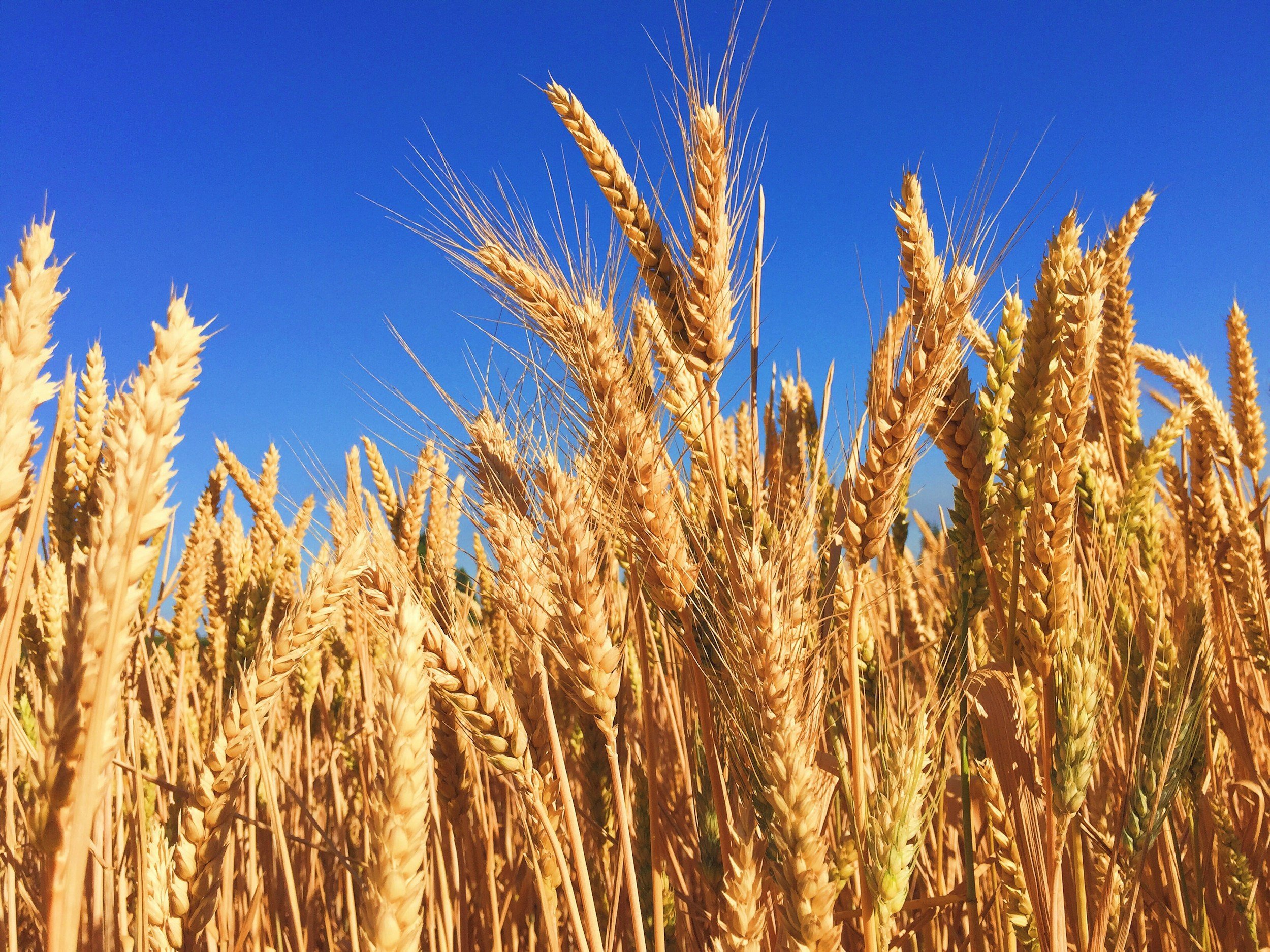
Wheat Among the Weeds
This sermon was preached by Pastor Ted Carnahan for the Eighth Sunday after Pentecost, July 19, 2026.
Grace, mercy, and peace be with all of you from God our Father and from our Lord and Savior Jesus Christ. Amen.
As we come into midsummer, you find more than just corn or beans growing in the fields. I know some of you would say, “I’ve never seen a weed, and if I had a neighbor who had a weed in his field, I wouldn’t be neighbors with him anymore.” Your fields are perfect; your rows are always straight. But it turns out that that’s a universal thing. It applies to everybody, whether you just have a flower garden or even a couple of pots on your back deck, or you’ve got hundreds of acres that you look after. You have to deal with weeds—especially with all the rain that we’ve had. Weeds love that. They love the sun, they love the heat, they love the water; sometimes they love it more. They love life more than the plants that we actually want, don’t they?
If you pull them up in a hurry, especially if you don’t recognize for sure what it is that you’re pulling up, you can cause a lot of damage.
Jesus starts teaching the people today and says,
“The kingdom of heaven may be compared to someone who sowed good seed in his field, but while everybody was asleep, an enemy came and sowed weeds among the wheat.”
The Temptation to Pull the Weeds Now
It’s tempting for us to want to be immediately on task, immediately after those weeds—where we go in and we say, “You know what? I want to take care of the weeds now. I don’t want them to get any bigger. I don’t want to allow this to continue, and so I want to take matters into my own hands.” As soon as they start to sprout up, I’m going to look at it and say, “You look like you’re going to be a weed,” and grab that and pluck it out.
And some of you, having a green thumb, might be better at that than me. In fact, if you have anything like a green thumb, you are better at that than me, because if I do that, I guarantee you that I will pluck up all the pretty flowers and you will have no vegetables or flowers—you will just have weeds.
We want to take matters into our own hands, and it’s not just a matter of our own personal human effort. It’s not just something that we can accomplish if we just get smart about the weeds. Sometimes it’s difficult to tell them apart. Sometimes you’ll hear this in older translations of the Bible: this parable is sometimes called the "Parable of the Wheat and the Tares." “Tares” refers to a particular kind of grass that has this remarkable ability to look almost exactly identical to wheat early on—with the key exception that if you grow a tare in your field, it will take up all the nutrients, the sunshine, and the water from the wheat, and it will produce exactly zero wheat. But you don’t know right away, do you?
Weeds Can’t Read
And it’s not just a matter of human effort, because if we just simply declare that we’re going to do better, that somehow that’s going to make things weed-free—I mean, we could try that, couldn’t we? We could say, “I hereby declare that Jackson County, Minnesota, is from this time forward and forevermore a weed-free zone! No weeds are allowed in here. We’re going to put signs up at all the roads into the county and say weeds are not allowed. We’re not doing that anymore. The weeds—it seemed like a good idea at the time—we’ve decided we’re cancelling weeds. Weeds aren’t happening anymore.”
But weeds can’t read, and so they don’t listen. They come here and they grow.
And of course then, if we are the people who are tending that ground, our tendency is to want to start examining those plants and looking at them extra carefully. And as soon as something—or maybe somebody—starts looking especially weed-like, "you are gone!" Because of course, we’re not talking about plants here today, are we? We’re talking about people.
People Who Seem Like Weeds
We live in a world where there are people who are more like weeds than wheat—people who seem to be committed to growing without growing up and to bearing the fruit that God calls each of us to bear. And it’s natural for us to become impatient, to say, “I am going to get rid of those people who I am just certain are never going to bear fruit.” It’s easy to say, “You, you over there, get out! I don’t want you in my life. You, you over there, you’re not worthy of being around here anymore.”
It’s natural for us to get impatient with sin. Sin is real, and sin is hard for us to deal with. And that impatience is difficult, but that impatience is not of God. It comes from our own sinful flesh, because we want to be in control. We want to be the ones who judge. We want to look at the beginnings that someone is making and say, “I know what your end is.” We want to see the sprout, and we want to judge the fruit—but we don’t get to do that.
We want to be in control, but God tells us in our parable today from Jesus that we don’t get to pull up the weeds, because in trying to do so, we will pull up the wheat.
We Must Wait
So we of course are even more offended when Jesus tells us that we have to wait. We have to wait, and not just a little while, but a long time. Not just one more chance, but a lot of chances. Both of them grow together until the harvest?
No, I would really rather take care of this immediately. But Jesus tells me to wait, and the prophet Isaiah in our reading today reminds us why we must wait. We are not the first, and we are not the last. We are not the beginning and the end. We do not know all things. We are not God. Our knowledge of what is going on around us is imperfect at best. Our judgment is limited, and we need to learn to be humble.
But there is one who does know what’s going on. There is one who is the beginning and the end, the first and the last. There is one who is the rock on which we can build our lives, and it is God. God is the only one who knows what the future holds. He’s the only one who can predict what the fruit will be. And so, when he tells us to wait, we have no choice: we must trust God.
Even when we are just sure that those other people around us are looking kind of weedy, even when we feel entangled by sin and death—usually the problem is not "those people over there." No, the problem is this person right here. (Not me personally—you too.)
The solution then is not frantic weeding, sorting ourselves out. The solution is patience and trusting the judgment of God.
Adopted, Not Enslaved
But too often we’re captive to fear. What will the future hold? Who can we trust? Who will truly be good? Will there ever be justice when I’ve been treated unjustly? Will God answer my cries?
But remember this: we have not simply received in Christ a new God to be a slave to. Let me say that again: We have not simply received a new God to be a slave to.
You see, sometimes your attitude—and honestly, sometimes my attitude—is, I just have to go and do the right things, and if I do the right things often enough, if I weed my own garden carefully enough, then I will be in a good place. And if not, well, that’s all on me.
But you are not merely enslaved instead to a better, different God. You have been adopted! You have been adopted into God’s family as his beloved son, his beloved daughter. You are part of God’s family in Jesus Christ. You have been made a child of the Most High God. You are now an heir. You are an inheritor of the kingdom of God.
You have a loving heavenly Father who does for us not what we demand, but what’s best for us and for all his children, which sometimes will leave us feeling very impatient and dissatisfied. And when we feel dissatisfied with that, as we all inevitably will, afflicted as we are by the evil and sin around us, we must remember that we will not be choked by weeds forever. We will not always be overcome with sin, but by persistent trust in the God who justifies the ungodly, we receive grace and forgiveness.
Jesus Interprets the Parable
Jesus interprets this parable for us so that we can’t miss the meaning. The sower of the good seed is the Son of Man. (In other words, the sower is Jesus.) The field is the world. The good seed are the children of the kingdom. God has planted good seed. But then also there are weeds, the children of the evil one, the enemy, the devil.
And there will come a harvest. There will come a time when the harvest is gathered in, where there will be a separation, where the evil will go away into everlasting punishment, and the good and the trusting in Christ will go off to eternal life. The harvest is the end of the age; the reapers are God’s angels.
And this is not something metaphorical that God is telling us about. It is real. It is part of His promise, which also means it’s true that there are those among us who are children of the evil one. And that also means that we need to examine our own hearts, because the line of evil runs through the hearts of every person in this room, me and you.
You Are Not the Reaper
But you are not the reaper.
And for us, yes, this is a rebuke. Our tendency to want to judge others too often blinds us to what God is doing in the hearts of the people around us. It blinds us to our own complicity in sin and our own sinful actions.
But if you think about it, it’s also a great relief, because it’s not your job to determine the final judgment of the heart of the people around you. Yes, it is your job to speak the truth. Yes, it is your job to do what is right. Yes, it is absolutely all of our jobs to defend the vulnerable against those who defy God. Absolutely. But to judge the heart? As a famous philosopher once put it, "that’s not your circus and those aren’t your monkeys." It’s not your job.
If you want to judge a heart, I’ve got one you can judge: judge your own, because there is a reaper who is coming, angels sent by our Lord Jesus Christ at the end of the age. And he, Jesus Christ himself, will deal with all causes of sin and all evildoers. He says, “My righteous judgment is coming and I will gather out of my kingdom all that defies me.”
This is not a joke and it’s not a metaphor. The proper place for weeds at the harvest is the furnace, burned up so that they can no longer spread their corrupting influence to others. And we who are the righteous in Christ are harvested into the barn, not because we chose to be good seeds, but because Christ who planted us made us what we are. Christ, crucified and risen, has transformed us for loving service.
Wheat Among the Weeds
And so in this meantime, we grow up as wheat among the weeds. And in that meantime, we tell the truth. Sin is sin and evil is evil, but we also wait patiently. And in the waiting, we trust — not with a spirit of fear or a spirit of slavery, but by keeping God’s words in mind. We wait in hope for the redemption of all things.
And in that waiting, we can trust that the Lord of the harvest will hold us in the palm of His hand. He gives you His promises. He gives you His holy word. He gives you His sacraments to sustain you so that you can remember that you are a baptized child of God. You have been made part of the kingdom of God by washing of water in the Word. You can be fed at the table of the Lord by the very body and blood of Jesus Christ. And therefore, you can rest in the assurance that you will be gathered into the Lord’s barn.
May the God who is your rock free you from fear. May the spirit of adoption teach you to pray to your heavenly Father and say, “Abba!”
And may the peace of God, which surpasses all understanding, keep your hearts and minds strong in Christ Jesus our Lord to life everlasting. Amen.