
Grace, mercy, and peace be with all of you from God our Father, and from our Lord and Savior Jesus Christ. Amen.
I really don’t know why people like the book of Jonah. I mean, I suppose I do know. It’s the swallowed by the fish part. It’s a fun story to tell kids, right? Jonah is going the wrong direction, there’s a big storm, they throw him overboard, the storm ends, but then what’s Jonah going to do, drown? No, God provides a fish. He’s swallowed by the fish, he’s thrown up on the land, and then he goes and does what he’s supposed to do. It’s sort of moralistic, but the problem is that Jonah is a profoundly unlikable character.
Jonah has been ordered to preach repentance to Nineveh, and we have to remember that Nineveh is not, they’re not just the next city over, they’re not just the folks next door. Nineveh are the hated enemy. Jonah hates the Ninevites. They’re from Assyria, and he’s being sent to go and preach repentance to these folks who are part of the Assyrian Empire. These are the enemies of Israel. These are the ones eventually who are going to come in, and as God’s judgment upon the northern kingdom of Israel, are going to come and conquer Israel and scatter the ten tribes, never to be seen again. So Jonah doesn’t just prefer not to go to Nineveh, he hates them with blinding hot rage. And on top of that, preaching repentance to Nineveh, to Jonah, feels like God is telling him to betray his people.
And so yes, he does go the opposite direction, and when he gets to the shoreline, he says, well, surely I could just keep going. He gets on a boat and keeps on going the opposite way from Nineveh, and the storm comes and they get scared and they pitch him overboard, and the storm goes away, and he’s swallowed by the fish, and he’s thrown up on the land. And he does sort of repent, at least he admits that he better go do what God said. But then when he gets to Nineveh, he preaches the most half-hearted but yet most effective short sermon in the history of the Bible: repent, or in three days Nineveh will be destroyed. And he’s hoping that this short sermon will not be believed. He does this for three days, he goes up on a hillside to watch. Meanwhile down in Nineveh, all the people are like, wow, this prophet out of nowhere shows up. They have no idea where he came from, but he says that if we don’t repent, in three days we’ll be destroyed. And everybody from the king all the way down to the lowest peasant, even the animals, put on sackcloth and ashes and repent. And here’s Jonah sitting on the hill. That’s our reading today. Jonah is sitting on the hill waiting, hoping, fingers crossed, that God is going to nuke these people. He wants them annihilated and he wants to watch. What a sweet guy, huh? What an awesome prophet of God. Oof, Jonah’s a difficult one.
And the worst of it is how petty he is, because he’s sitting up here on the hillside and it’s hot. It’s kind of an arid, semi-desert area, and he’s sitting on the hillside and he’s waiting for God to send fire and brimstone and annihilate a hundred and twenty thousand people, and he’s hot. And so God appoints a vine to grow up and give him shade, and he feels good about that, and he’s like, God’s on my side. And then the next day God appoints a worm, and the worm kills the vine and it withers, and he gets angry with God, and God asks him, is it right for you to be angry? And he says, yes, angry enough to die. What a loser.
Jonah’s problem is that God is merciful. In fact, he quotes Psalm 145. The reason we had Psalm 145 as our reading today is because he quotes that particular Psalm to God, but he doesn’t quote it as praise, he quotes it as accusation. The Lord is gracious and merciful, slow to anger and abounding in steadfast love. But coming out of Jonah’s mouth, it doesn’t sound lovely and hopeful. It comes out with venom and bitterness. The Lord’s mercy is beautiful when it’s directed at Jonah, but it makes him mad when it’s directed at his enemies.
This is the challenge that Christ brings us today in the gospel. But aren’t you glad that Jesus is so merciful to you? Because if you have any sense of your own sin, if you have any sense of your own need for forgiveness, then what Jesus Christ accomplished for you on the cross is wonderful news. He died on the cross for your sins, he rose for your justification. He ascended to the right hand of the Father, intercedes for you today in front of the Father. He’s praying for you right now. So if you have any sense of your own sin and the grace of God in Jesus, of course you’re glad, of course you’re happy, of course you rejoice in that. But can you be glad that Jesus is merciful to someone else, maybe even someone you don’t like?
And so Jesus tells a parable, and he frames the story this way. There’s a landowner. And the landowner is going to go hire day laborers to work for a normal day’s wage. It’s not an extraordinarily generous sum, it’s not an extraordinarily miserly sum. It’s just the normal amount. He’s going to pay them one denarius. If you were here last week you know that last week we were talking about the slave who owed his master ten thousand talents, which is like two hundred thousand years’ work. And he says, be merciful to me and I will repay, which of course is silly, he can’t do that. And he’s forgiven, but he won’t forgive his fellow slave who merely owes him a hundred denarii, a hundred days’ wages, which is a lot of money but it’s not an insurmountable amount.
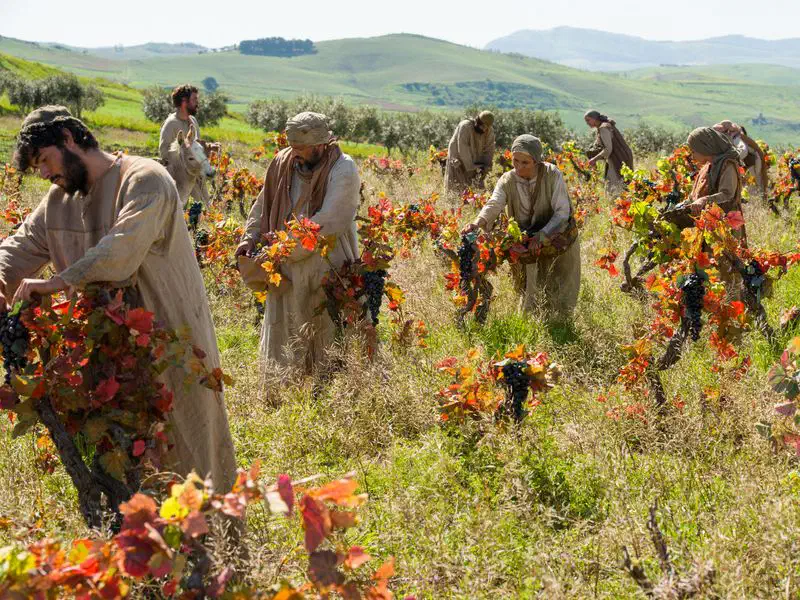
So the guy goes to the place where all the day laborers hang out, and he offers them a fair wage for a fair day’s work. At the start of the day he hires them, they come, they start working in his vineyard, life is good. It gets hot, they get sweaty. Meanwhile the landowner goes back to the place where the day laborers gather and he hires some more and says, I will pay you what’s fair, and they say okay, and they come to the vineyard. And then he does this again: he does it at nine a.m., he does it at ten, he does it at three, he does it at five. And then the night begins to fall and it’s time to pay them their wages. And he deliberately lines them up this way: those who came last are first in line.
And so the ones who have only worked in the evening in the cool, just a few hours, are first in line, and the men who have worked all day, have borne the scorching heat, who have put in all the effort, they’re at the end of the line watching, and he pays them out one by one. And so the first folks in line, the people who have been there the shortest amount of time, they come and the landowner opens his purse and he pays them a denarius, far more than what they really deserve for the amount of work that they put in. They only worked a couple hours, and not even at the hottest point of the day, and yet they get the complete day’s wage. And the guys in the back are going, this is going to be great. And then it goes one step further. The next step is saying, here is, you know, we have some folks who have been here not most of the day but half the day. And the landowner opens his purse and pulls out a coin and pays them one day’s wage. And the guys in the back are like, wow, this is great. These guys are really generous. Those guys did half the work that we did, so we’re going to be getting twice as much. And then it goes on and on until finally the people who have been there all day are getting paid, and the landowner reaches in his purse and pulls out one day’s wage. And they are mad. Their complaint is bitter. You have made them equal to us. What about the hard work? What about the scorching heat? What about the many more hours that we worked rather than they? How is it that they received the same reward that we receive?
And they’re not wrong. They have worked longer and harder. They have worked in more unpleasant conditions. But they haven’t been cheated, because they’ve been given exactly what they were promised. The contract has been fulfilled. They were paid what they were owed. No more, no less.
This is sometimes what we call in the church the scandal of grace, because we figure that we have earned what God has given to us. Look at me. I’m a hard working person. I do good things. I don’t do bad things. I try to avoid that as much as possible, because they’re called bad and bad things are bad. So I try to do good things and not bad things. I try to live an upright life. I try to do socially acceptable things, and I try to get people to be looking at me in a positive way. We figure that somehow this means that we have earned the grace of God, and then we see someone enjoying the same things but having worked much less, and we get frustrated.
How is it that people who come to church way less often than I do get the same grace from God that I do? How is it that the Christmas and Easter family gets the same heaven I do? How is it the one who mistreated others gets to repent and receive exactly the same wage, eternal life and salvation, that I’ve received? How is that fair?
Today we get to see this dynamic at work. We have a baptism. Bennett Olson will be baptized. He didn’t attend catechism class, because he’s like this big. He didn’t volunteer in the church kitchen. I wouldn’t even let a baby do that. He didn’t pray a special prayer. He has done nothing to earn or deserve the grace of God, but he will still receive the same baptism that you have. He will receive the grace of God in Jesus Christ having done nothing to earn it, nothing to deserve it.
For that’s how all of us come before God. Not through a contract where you agree with God to be good and he promises to give you eternal life in exchange. Okay, God, I’m going to be basically socially acceptable and mostly good. You’re going to overlook the things that I’ve done wrong, and in the end you’re going to pay me what I’m owed, and it’s going to be a huge drag and I’m not going to enjoy it at all, because being good is not nearly as much fun as being bad, of course, but it’s a contract. We shook hands on it. It’s a deal. No, but rather we receive what God gives through a promise, where God has blessed and chosen you to work in his kingdom, where he has said to you, come and follow me, and we take up our cross and go, so that many will see and know the goodness of God and his kingdom.
This then means that your role is not to count the cost, to uphold your end of the deal, for you do not uphold your end of the deal. You sin daily in many ways, most of which you are not even aware of, but still are responsible for. Your role is not to count the cost and decide whether the investment is worth the risk. Your job is to not begrudge the grace of God to others.
In fact, St. Paul shows us the example here in our reading this morning from the Epistle. He would rather die and be with Christ. He explains that he would rather, if it were up to him, not for all of the suffering that as an apostle of Jesus he’s had to suffer, not suffer the beatings and the rejection, the sleepless nights, the sleeping outside, the shipwrecks, the arrests. It would be much easier and more pleasant for him if he were to simply go to Jesus and say, Jesus, take me home now, so I don’t have to endure the suffering that the cross has brought into my life. But then he says, for the sake of his church and the kingdom of God, not just the church in his day, but for the church in our day as well, he remains in the flesh to do what is necessary for the kingdom.
He chooses the harder road, the less desirable thing, the longer one. He endures the scorching heat and the hard work in the middle of the day, not for his own sake, to earn for himself a better salvation, but because there are others who need God’s grace too, and that would be you and me.
And in that way, I think St. Paul is the anti-Jonah. Think of it. Both men want out of this life. St. Paul says it would be better for me to die and be with the Lord than to live and suffer all of these things. And Jonah also would rather not preach repentance to the Ninevites, because he’s afraid that they might actually repent and God might actually forgive them. And it would be better for him to die, he says. But here’s the difference: Jonah sees hated others as people to turn his back on and to run away from serving. St. Paul sees others as potential believers for whom Jesus Christ has died.
That’s what life in the kingdom looks like. By intentional work and God’s grace over time, the Spirit of God develops in our hearts the necessary disposition. We learn to cling not to what we can offer God, for we can offer God nothing really. We’re like children making mud pies and then showing our parents. Look what I made. Oh, great. A mud pie. But instead, we learn to love the work, not for our own sake, for what we earn, but for Christ’s sake. And we learn to love the kingdom of God, not because she’s perfect, but because she belongs to Christ. And we learn to love the church, not because it does everything exactly as we like it, but because the church is the bride of Christ. In that love, we find God’s purpose for us.
Therefore, go and show the kindness of God to all people. Be Paul, not Jonah. Be the landowner, hire them and bring them into God’s church with the promise of eternal life, but paying each the same, so that we all can receive the baptism life which God gives out freely, together. And may the peace of God, which surpasses all understanding, keep your hearts and minds strong in Christ Jesus our Lord to life everlasting. Amen.