
“Grace, mercy, and peace be with all of you from God our Father and from our Lord and Savior Jesus Christ. Amen.”
Our confirmands have come here today to proclaim their faith, to affirm their baptisms, and to state what it is that they believe.
And I thought that there was something very remarkable about the faith statements that I found, and the verses that they chose this year, Noah picked 1 Corinthians 16:14, let all that you do be done in love. But later in his faith statement, he talked about God giving him courage, and you’ll hear that in a little while. Jaya picked Matthew 6:34, “Do not worry about tomorrow.” Hmm, Jena picked Isaiah 41:10, “Do not fear for I am with you.” And Ady picked Deuteronomy 31:8, “Do not fear or be dismayed.” Do you hear the pattern? They’re all talking about fear. I thought that was interesting.
14-year-olds-ish, 15 in some cases. They’re all 15? In Jackson, Minnesota, 15-year-olds in 2026, had to choose for themselves confirmation verses, and on their own, and independently, all chose verses that promise that we do not need to be afraid. Nobody assigned those verses to them. I didn’t make them pick that, though we didn’t have a meeting and decide, “Okay, we’re all going to pick the ones that show that we need courage in this world.” But all of them managed to do that this year.
What do you do with a promise from God that says, “You do not need to be afraid. Do not worry about tomorrow. Do not fear for I am with you. Do not fear or be dismayed.” What do you do? Do you resolve to be braver? Does that actually work? I think bravery is one of those things that you either are or you aren’t. I don’t think that you can choose to be more courageous than you are. I don’t know, I think it was Clint Eastwood who said something like courage is not the absence of fear, but it’s being afraid and strapping on your boots anyway or something like that. Do not be afraid today is not advice. It is a promise of company, of companionship. Somebody says it standing next to you. Who comes alongside you and says, “Do not be afraid,” is promising to be with you.
Here in our gospel lesson this morning, Jesus says, “If you continue in my word, you are truly my disciples.” And there’s one word that hangs around that phrase or that sentence that bothers me, that it gnaws at me, it tears at me. And here’s the problem because I’ve lived this, here’s the weighty word and it’s the smallest word in the sentence, if, if you continue in my word, you are truly my disciples. And for me, that feels like a condition, that feels like I have a yes or a no, I have a decision to make, I have a choice to make in order to decide, “Am I going to do this?” It feels like a condition, a rubric, someplace that I get graded. If you continue in my word, continue sounds like the assignment, just like memory work was an assignment that we’ll say some of you did. And sermon notes at one time, I think, for you still, and faith statements certainly, as we will all hear a little bit later, or that dreaded one-on-one examination with the pastor at the very end that I know that they were all a little bit nervous about. It feels like an assignment, something to do, something that you must be and choose in order to be counted as acceptable.
But this room is full of people who did not keep that promise, full of people who did not continue. And I am chief among you because I didn’t keep that promise, in fact, I heard those same words, the same text preached at my confirmation, and then three weeks later, having heard, if you continue in my word, you are truly my disciples, and you will know the truth, and the truth will make you free. And my reaction, literally, three weeks later, was I quit church. And I didn’t go back in any serious way for three and a half years until I was returned to it by the grace of God and a crush on a girl. That was her evangelism strategy, by the way. If you want to date me, you have to go to my youth group. And I said, “Well, I don’t believe anything that you believe, but you’re cute, and I do anything to date you. So here I am.”
And it wasn’t Jennifer either, yeah. That had been an even better story, wouldn’t it? Darn it. I only dated two people. Jennifer was number two. But she’s number one in my heart, man, that sounded bad, didn’t it? I got to be careful how I say things.
But let’s be honest, folks. This room is full of people who did not continue in his word, maybe even were confirmed, maybe even confirmed here at this altar and that didn’t continue. Maybe they walked away at 19 and then they were back at 40 for a funeral. Maybe they sat in the back row for a decade, trying to figure out whether this was something they even believed in or not. And so the problem with this teaching of Jesus is that if we understand it as a condition, if we understand and hang all the weight of it is if, verse 31 is a condition that I can’t meet, and most of you can’t either. If you continue in my word, you are truly my disciples, well, I haven’t, Lord. What can I do about that?
The Pharisees are offended. I mean, the Pharisees are often maybe usually offended about something, but they’re offended today because Jesus says, “You will know the truth and the truth will make you free.” And what is it that they say? We are descendants of Abraham and have never been slaves to anyone, which is about the stupidest thing I’ve ever heard because not only are they offended, but they’re wrong about the facts. They’re standing in conquered territory in the Roman Empire as they say, “We’ve never been slaves to anyone.” And they’ve forgotten that most of their prophets, the ones that they remember the most, were prophesying hope in the midst of the Babylonian exile or perhaps Egypt when they were literally slaves or Assyria. All these other empires that had conquered them, made slaves of them, made servants of them, and they’d say, “We’ve never been slaves to anybody.” Yeah, actually you have, but you’ve got a bigger problem than just slavery to some earthly authority. Your problem is you’re slave to sin. And so an offer of freedom is insulting until you know that you’re not free.
That’s why, for example, this church will not skip the law on its way to the gospel. We will not skip God’s judgment on the way to grace because if you don’t know and believe in your bones that you are a sinner in need of a Savior, then when you hear that Christ has come to make you free, you’ll have no use for it. A kid who has been raised their whole life being told that they’re basically fine and they’ve basically never really done anything wrong is somebody who comes to the message of Jesus Christ and hears, “Yeah, whatever, I don’t care.”
Fortunately, these four have not learned to be offended by their false sense of piety, which is actually a gift. It’s why their verses are so honest. They tell the truth. They’re a little bit afraid. Not just because they have to stand up in front of you all here in a couple of minutes, maybe that too, but also because the world is not an easy place.
Jesus helps us understand this. He says, “The slave does not have a permanent place in the household. The son has a place there forever.” In this case, I think sometimes we misunderstand what’s going on here because our idea of slavery is the terrible, back-breaking, horrible, chattel slavery of the American South prior to the Civil War. Slavery looked different in the ancient Near East, but you still had your status defined by somebody else and told what you could do, what you can’t do, and so the slave’s problem that Jesus is speaking of is not cruelty of a whip, necessarily. It’s more a pink slip, the idea of being well-fed and well-liked and then being one bad season from being discarded as useless.
The fear that I think is hiding behind the verses in the gospel today is not a fear of something bad happening. It’s a fear of not belonging. I think what our confirmands are showing us today is something that we also know that we need. We have a need to belong. What Jesus tells us is the son’s place is not earned, right? This slave does not have a permanent place in the household. He can be sold and traded away, and whatever, but the son has a place there forever. It is not earned, it is not deserved, and it does not expire. You’re a child of the father only because that’s who you are. It can’t be traded away. It’s immutable. It can’t be changed. His family and family is a different category from staff.
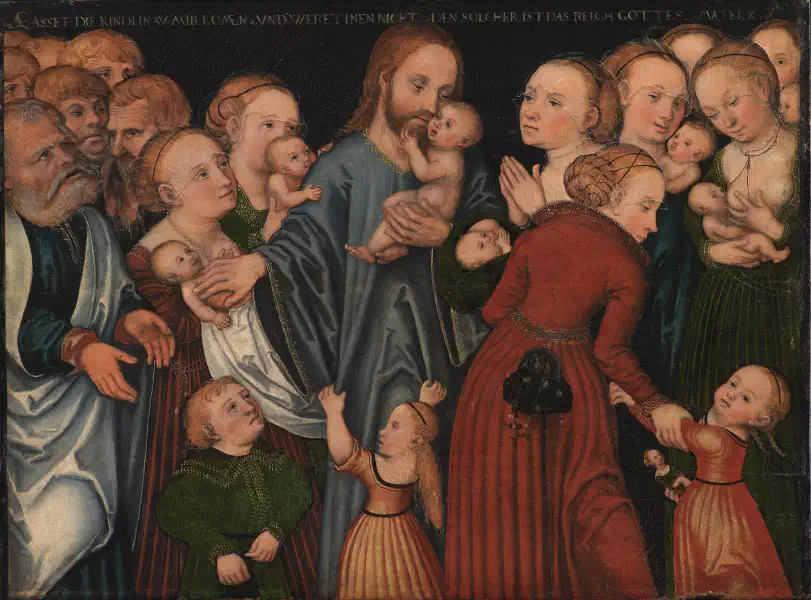
Look on your bulletin for a moment with me. We know that Jesus didn’t have any earthly children of his own, but we also know that Jesus welcomed the little children. This is a painting from Lucas Cranach, the elder, painted in sometime after 1537. We don’t know the exact date, where Jesus is having all these little children brought to him, and he welcomes them. Not because they had made some great special proclamation of faith, they didn’t stand up and get confirmed, they were little babies, but he welcomed them because of who they are. They are beloved children of Jesus, and that’s the place that we are handing to our confirmands today.
This is your home. These are your people. For better or worse, we’re not perfect, but no matter what you face, whether you’re at 15 years old at a microphone sharing a faith statement, or you’re 19 years old in a dorm room, with nobody checking up on you anymore and feeling a little bit like you’re off the leash, or you’re 30 and you’re tired and you’ve got a kid of your own, and maybe you have more questions than answers. There’s something in the gospel of Jesus for you, a place and a people to belong to.
In our reading this morning, Jeremiah the prophet speaks of a new covenant. It will not be like the covenant that I made with their ancestors, a covenant that they broke. That’s a covenant of obedience. God said to the people of Israel, “Do this, and I will bless you. Don’t do it, and I will curse you.” The new covenant that Jeremiah the prophet speaks of, the new covenant created by Jesus Christ, is this covenant which is not this for that, because we break the covenant that says be good, but when God claims you, we do not lose the covenant, be God’s. Belong to the Lord Jesus Christ. Every one of us in this room fit into that category, those who have broken the covenant and yet are beloved, and claimed, and chosen, and loved by God. And God puts it this way in the mouth of Jeremiah the prophet, “I will put my law within them, and I will write it on their hearts.” He promises that when we don’t continue, that He will continue for us, that He will call us back to repentance and faith, because it’s always, always, always been about repentance and faith, about recognizing our deep need for the things of God and trusting that God has provided those for us, especially in the person and work of Jesus our Savior, which is why Jesus’ opening phrase in our gospel today, “If you continue in my word,” stops being a condition, and it starts becoming a promise, a promise with your name on it.
Soon, our confirmands will confess with us that they are made free in the gospel, that this place, that this people are theirs, and they’re laying a claim, a place in the household, a spot reserved for them at the altar, a participation in the body and blood of Christ, a door that is open to them forever, which is, thank God, nothing less than what any of us get. A place where you’re welcome, where you’re loved, where you’re forgiven and free. In Jesus’ name, amen.