
“Grace, mercy, and peace be with all of you from God our Father and from our Lord and Savior Jesus Christ. Amen.”
We come to this All Saints Day with a lot of different emotions. Some of you didn’t know it was All Saints Day until you came today. If that’s you, that’s okay. Welcome. This is not one of the better known Christian festivals, but it is an important one. Some of you thought, certainly last night having been Halloween, it must be a Halloween service or something like that. You’re close. Last night actually was the Feast of the Reformation or Reformation Day, October 31, 1517. The Blessed Martin Luther nailed 95 theses or debating points to the Castle Church door at the All Saints Church in Wittenberg, Germany asking for a debate about abuses that he saw in the medieval Roman Catholic Church. And so some might think and expect to be celebrating that, but we did that last week.
So instead today we find ourselves celebrating on the actual day, November the 1st, All Saints Day. A day when we come to hear what Jesus Christ says about sainthood and also to hear what it is that is true about those who have gone before us and now are at rest in Christ.
We come to this All Saints Day and we’re confronted with a gospel text. It’s from the Sermon on the Mount, Matthew chapters five through seven. That’s the Sermon on the Mount. And this is right at the beginning, the first twelve verses of Matthew chapter five. And I believe that here Jesus is giving us his definition of what makes a saint. And he gives us a list of nine things. Blessed are the poor in spirit. Blessed are those who mourn. Blessed are the meek. Those who desire righteousness. The merciful. Blessed are the pure in heart. The peacemakers. The persecuted and the reviled. Theirs is the kingdom of heaven. It is an odd list, especially because a lot of these things we don’t think of as being blessings. It is no blessing in my opinion to be reviled by people. It is certainly not blessed or doesn’t feel blessed to mourn. And sometimes when I would rather pursue justice than mercy, being merciful doesn’t feel like a blessing.
But notice what Jesus says. The Word of God, the Son of God, comes and speaks to you this day and says, blessed are all these things. Even though the world doesn’t look at it that way, even though the world looks at these things and says that there is no blessing in these things which are mostly seen in a worldly way as negative, he says that these are blessed, present tense today.
And each one of them also has a promise attached. Blessed are the poor in spirit. Blessed, for theirs is the kingdom of heaven, right? But then blessed are those who mourn, for they will be comforted. Notice present tense, they are blessed. Why? Because in the future they will be comforted. Blessed are the meek, that’s present tense right now, for they will inherit the earth. Blessed are those who hunger and thirst for righteousness right now, for they will be filled. And then Jesus says, rejoice and be glad, which is a weird thing to say. You who are poor, who mourn, who are persecuted and reviled, rejoice. It’s not super fun. But 1 John 3 reminds us today, we are God’s children now. But what we will be has not yet been revealed. The gift is already in hand. The present has been received. It is wrapped and under the tree and it will be unwrapped when Jesus returns.
In fact, as we come into the month of November, and it’s kind of hard to believe it’s November already, our readings in the church, according to the traditional pattern of readings that we use, our readings which incline us towards the end of the world, the second coming of Jesus Christ. And then at the end of the church year, we will say Christ is king and turn right around and celebrate Advent the next week as we prepare for the first coming of Christ and celebrate Christmas. This annual pattern of rotating readings fits us into the life and death and resurrection of Jesus.
And as we do that, this month in particular, November, points us ahead to the future when Christ will come again and shows us the gap between the present day where we stand right now, where Jesus can confidently say to you, “Blessed are you who mourn, who hunger, who are poor in spirit, who are meek, for there is something coming in the future that is better than this. Blessed are you now because you are the recipient of a promise that will be fulfilled at the return of Jesus Christ.” And the distance, the gap between where we stand today and where we are going in the future. We call that Christian hope.
But we also need to come to this day with honesty because on a day called All Saints Day, I don’t know about you, but most of us aren’t that saintly. Am I meek? Am I pure in heart? I mean, some of us are better at some of this than others. Some people are more meek than others. Others probably have a gift of being more pure in heart, but nobody in this room fully embodies these nine principles, these nine beatitudes, as sometimes they are called, or blessings that Jesus gives us in his definition of sainthood. Some may be more than others, but none of us compare favorably to Jesus’ list. We’re majoring in the minors and jockeying for who is first, and meanwhile Jesus is up here saying, “Come and follow me.”
In fact, when we see a list like this, it shows us what holiness looks like, our first reaction, deep in our spirit, the sin that has contaminated our souls, looks at a list like that and rebels against it. How can you tell me what’s blessed and what’s not? I think that Jesus is giving us the job description for sainthood, but if it is the job description for sainthood to be poor in spirit, mourning, meek, those who desire righteousness, the merciful, the pure in heart, etc., then I think that All Saints Day needs to be renamed. Maybe we don’t need to call it All Saints Day anymore, maybe we ought to call it All Ain’ts Day, because I ain’t so poor and I ain’t so meek and I ain’t so righteous, that’s for sure, and I ain’t so merciful and I ain’t so pure. Neither are you, but here we find a powerful truth.
Jesus says over and over again that something is coming, which is better, that the gap, the chasm, the canyon between where we stand today in the present and what’s coming for us in the future will be bridged. He tells us theirs is the kingdom of God.
It reminds me of our reading today from Revelation chapter 7, the robes of the faithful being made white, pure, spotless and holy in the red blood of the Lamb of God, which is, if you think about it, an odd way to do laundry, but a wonderful way to be saved from sin. The blood of the Lamb of God, Jesus Christ, the incarnate Son of God, His blood is the only thing that can save you from your sin, which can make you pure and righteous before God, which can, in short, make you from an ain’t into a saint. And when you are saved from your sins, then you have promises that are fulfilled in His Second Coming. You have eternal life. You have righteousness before God. You have salvation.
The saints that we are celebrating today, therefore, are not the really good people. Some of them were quite ordinary saints. The saints are those we remember who have been washed in the blood of the Lamb of God, Jesus Christ. They’re the ones who we remember who are God’s people. Notice, watch your tenses again, who are God’s people, not who were God’s people, not just something that they did in the past, because who cares what they did in the past? They aren’t made righteous by what they did in the past, they are made righteous in the blood of the Lamb of God, Jesus Christ. And they are here among us and with us today. We are surrounded by a great cloud of witnesses living and dead across time and space, united in the communion of saints, gathered around the throne of God. We come as we come each week to the altar and receive with them the promises He has given us in His body and blood in Holy Communion.
And this is also because this is a day when we remember and mourn our dead. We are reminded of a powerful promise embedded in those beatitudes. Jesus says this, “Blessed are those who mourn, for they will be comforted.” That doesn’t mean that we always have the answers. It doesn’t mean that we have all the explanations. It does mean that God has given us a promise. He will give us comfort because those whose lives are washed in the blood of the Lamb receive salvation and we will be with them. And so yes, tears are here with us today. The long list of names we have, people who have died this year, certainly show that and we’ll read those names a little later.
But we also hold on to hope. We are with Christ. We are with Christ in the book of Revelation. Too often the book of Revelation comes to us as something that is to be feared, something which is uncomfortable, something which is cause of worry. I don’t think that that’s the case. I think the book of Revelation is a book of hope. We have come out of the great ordeal that’s being described in chapter 6 of Revelation. And in our reading today, having come out of the great ordeal. And this is one of my favorite little words in Greek. It’s because it’s fun to say. It’s thlipsis. Thlipsis means squeezing. The great ordeal has all this weird left behind stuff attached to it. But the simple idea here, the great ordeal is just the great squeezing. And you know the pressure of the great squeezing. You felt the pain of death in your chest. You have been through a great ordeal in this life already and probably have more to face yet in this life. Real life here today is a great squeezing that we feel tugging at us. A sense that the world as it is today is not right and that something has gone terribly wrong. The ordeal, the squeezing, it is not some imagined future worsening of things. It is what we have to face here and now. And money and status and fame don’t get us out of it.
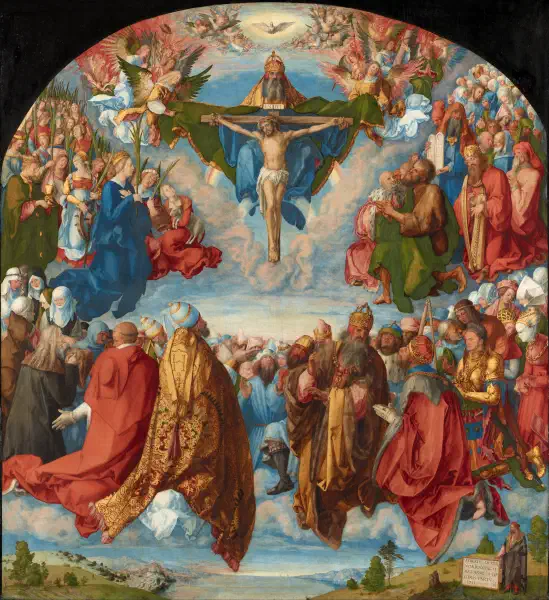
Briefly, we have this painting that’s kind of cropped in a little bit, but it’s the Feast of All Saints. This was painted by a painter named Durer, Albrecht Durer, on the adoration of the Trinity 1511. That’s what the name of the painting is. And it was painted for an altar that was commissioned by a man named Landauer. That guy created a chapel called the Zwölfbrüder House, the Twelve Brothers House, because there were 12 artisans who cannot support themselves. And so he built them a place both to live and to do their work.
And I won’t go into all the details of it. It is a beautiful and detailed painting, but what you see, especially if I didn’t have some of it kind of superimposed by important information here, is you would have all the ordinary people gathered around, including the pope and the emperor and even Landauer himself and Durer paints himself in the corner holding a sign. And then above him the saints flanked by Mary and John the Baptist. And in the center, a representation of the Holy Trinity, Jesus Christ, the Son of God and the Holy Spirit. This is a picture of the crowds of people already dead and those having died and now at peace and in heaven with God gathered around the throne. Not one person is on that painting because they earned their place of salvation by their good works. Not even Landauer who paints himself as just one of the pilgrims on the way or has himself painted or Durer who puts himself in the corner, least of all. We don’t come to saintliness by unblemished moral purity.
I’m reminded that our psalm today was written by a complicated person, King David. And that psalm, that psalm which lifts up God’s justice and goodness came at one of the worst moments of David’s life. On the run from Saul, faking insanity in front of a foreign king, letting spit run down his beard so that he would look like he’s a crazy person. Yet in spite of our moral ambiguity, in spite of our sin, we come to a holy and righteous God who loves us.
You have been adopted into God’s family. Say what? Here’s what John the Evangelist says to you in 1 John chapter 3 today. See what love the Father has given us, that we should be called the children of God, and that is what we are. We have been made children of God, adopted into God’s family not by how good we are but how good God is. He has rescued you and welcomed you into his family. We are not saints of ourselves. We are made saints in Christ. We are purified by the hope that we have in the future completion of God’s promises. We can stand firmly planted in the here and now and look to that future day and say, “I believe that that is true and I will cling to that hope.” First John 3:3 says, “All those who have this hope in him purify themselves.”
So today we gather in a promise, “The lamb at the center of the throne will be their shepherd, and he will guide them to springs of the water of life, and God will wipe away every tear from their eyes.” If your eyes have been full of tears this year because those close to you have died and now are in the bosom of Abraham, they are now in the presence of Jesus Christ. Remember that the hand that wipes your tears this day is the nail-scarred hand of Jesus Christ who died for them and for you. Trust this promise, receive him in bread and wine, and know the hope that comes only from the one who suffered with us and for us to give us life. In Jesus’ name, amen.